
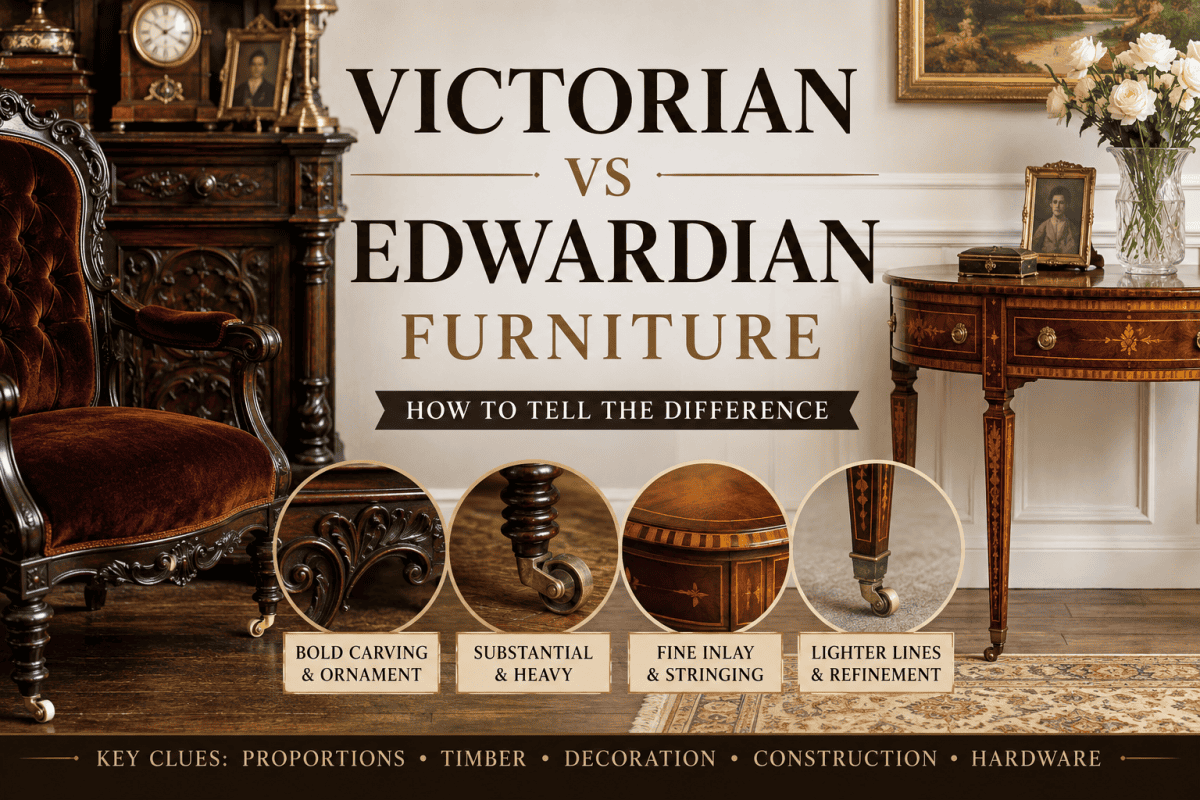
Victorian vs Edwardian furniture can look surprisingly similar at first glance. Put a Victorian armchair beside an Edwardian one and the difference may sometimes seem obvious: one substantial, dark and richly upholstered; the other lighter, more delicate and restrained. In practice, antique furniture rarely makes identification quite that easy.
The Victorian period lasted from 1837 to 1901, while the Edwardian era followed from 1901 to 1910. Furniture did not suddenly change when Queen Victoria died, however, and styles frequently overlap. Late Victorian furniture can look remarkably Edwardian, while traditional designs continued to be made well into the twentieth century.
So, how can you tell Victorian from Edwardian furniture? The answer lies in examining several clues together: proportions, timber, decoration, legs, castors, upholstery, construction and hardware. No single feature should determine the date.
Quick Answer: Victorian vs Edwardian Furniture
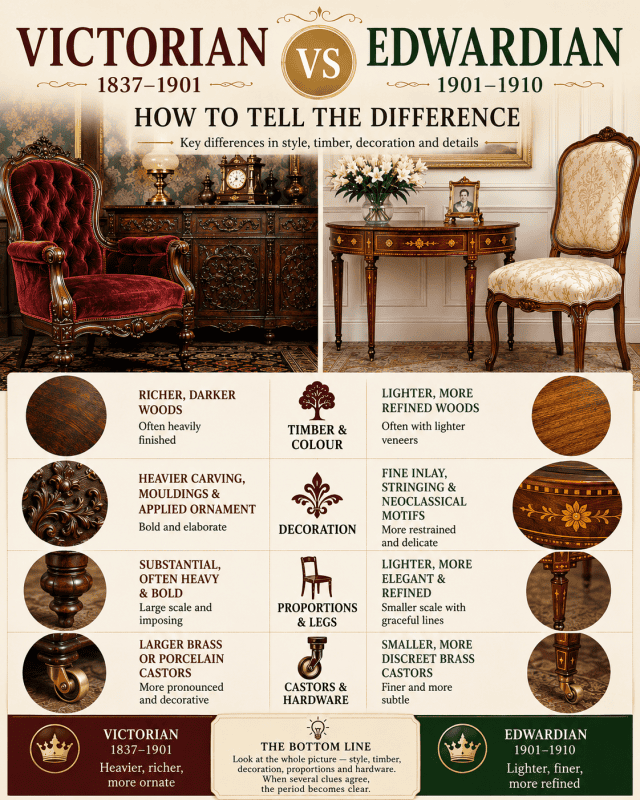
Victorian furniture is generally heavier and more substantial, often using mahogany, walnut, rosewood or oak with carved decoration, deep upholstery and strong proportions. Edwardian furniture tends to be lighter in appearance, with slimmer legs, finer proportions, satinwood or mahogany veneers, delicate stringing and inlay, and decoration influenced by earlier Georgian and neoclassical styles. However, Victorian vs Edwardian furniture can overlap considerably, so always examine construction, hardware, timber and design together before assigning a date.
Victorian vs Edwardian Furniture: Start With the Overall Shape
Before reaching for a magnifying glass, stand back and look at the whole piece.
Victorian furniture often has visual weight. Dining tables have substantial legs, wardrobes can dominate a room, and upholstered chairs frequently use deep seats, broad backs and generous amounts of timber. Much of this furniture was designed for interiors where substantial furnishings communicated comfort, permanence and prosperity.
Edwardian furniture often creates a different first impression. Legs become slimmer, cabinets stand more lightly on the floor and chairs frequently have more open backs. Even relatively large pieces can appear less imposing.
This difference is useful, but it is only a starting point. Victorian Britain produced everything from massive Gothic Revival furniture to remarkably delicate drawing-room chairs. Likewise, plenty of substantial furniture continued to be made during the Edwardian period.
The experienced eye therefore uses proportion as the first clue rather than the final verdict.
Dealer’s Tip
“Never date antique furniture from one attractive clue. A castor, handle or piece of inlay may have been replaced during the furniture’s lifetime. The strongest identification comes when the timber, proportions, construction, decoration and hardware all tell the same story.”
Dark Victorian Furniture and Lighter Edwardian Woods
Timber provides one of the first clues when comparing Victorian vs Edwardian furniture, but it is also responsible for one of the most persistent myths in antique furniture: Victorian means dark and Edwardian means light.
There is a grain of truth behind the idea, but certainly not enough to date a piece of furniture by colour alone.
What Woods Did Victorian Furniture Makers Use?
Mahogany remained enormously important throughout the Victorian period and appears in everything from imposing dining furniture to beautifully made chests, tables and smaller domestic pieces. Walnut became particularly fashionable during the middle decades of the nineteenth century, especially for drawing-room furniture, chairs, occasional tables and cabinets.
Rosewood appears on finer nineteenth-century furniture, often as a veneer, while oak enjoyed repeated revivals. Victorian oak can be heavily carved and architectural, particularly on Gothic Revival furniture, but by the later nineteenth century it also became an important timber for Arts and Crafts makers who appreciated its strength, grain and distinctly English character.
Therefore, timber species alone rarely provides a neat Victorian date. What becomes more revealing is the way the maker used it.
Why Does So Much Victorian Furniture Look Dark?
Walk around an antiques centre and much of the Victorian furniture will indeed appear considerably darker than nearby Edwardian pieces. However, that does not necessarily mean it looked exactly like that when it left the workshop.
Old finishes change. Timber oxidises, varnishes and shellac can darken, and generations of wax and furniture polish gradually alter the surface. Add decades of coal fires, tobacco smoke, dirt and enthusiastic polishing and a piece can acquire a depth of colour its maker never intended.
This is particularly noticeable when a protected area becomes visible. Remove an old handle, lift a fitting or inspect timber that has spent a century hidden from daylight and you may discover a surprisingly different colour underneath.
That contrast can itself become useful evidence. It reminds us that we are examining both the original timber and everything that has happened to its surface since.
Edwardian Furniture Did Not Abandon Dark Woods
The arrival of the Edwardian period did not send mahogany out of fashion. Far from it. Mahogany remained extremely popular, particularly for the elegant revival furniture inspired by eighteenth-century designers such as Sheraton and Hepplewhite.
The difference often lies in how makers presented it.
Instead of relying on broad areas of heavy carving, an Edwardian cabinet or occasional table might use a fine mahogany veneer enlivened by boxwood stringing, contrasting banding or delicate marquetry. Satinwood and other lighter decorative veneers also worked particularly well with the period’s renewed enthusiasm for neoclassical design.
As a result, even an Edwardian piece made predominantly from mahogany can feel visually lighter than a Victorian piece made from much the same timber.
Look Beyond the Colour
When examining an unidentified piece, try to forget the simple rule that dark means Victorian and light means Edwardian. Instead, look at the grain, veneer, finish and decoration together.
Is the timber solid or veneered? Does the maker use broad carved surfaces or delicate contrasting lines? Can you see banding around drawer fronts or the edges of a tabletop? Is there fine boxwood stringing? Do protected areas reveal a different original colour?
A substantial carved mahogany sideboard and a finely veneered mahogany occasional table may share the same basic timber, yet their proportions, construction and treatment of that timber can place them within very different design traditions.
This is why identifying antique furniture becomes much more reliable when you stop asking “What colour is it?” and start asking “How did the maker use the wood?”
If you are learning to judge antique furniture more generally, our guide to how to identify antique furniture explains the wider clues worth checking, including construction, timber, hardware and signs of later alteration.
Learning to recognise timber becomes much easier once you have handled plenty of furniture, but a good visual reference can help enormously. Terry Porter’s Wood Identification & Use (Updated Edition) covers more than 200 wood species with colour photographs and information on their characteristics and uses. It is a useful reference for anyone who wants to become more confident distinguishing the timbers encountered in antique furniture.
Carving, Inlay and Decoration: One of the Best Clues
Decoration can reveal much about the design tradition behind a piece.
Victorian furniture enthusiastically borrowed from the past. Gothic arches, Renaissance carving, Rococo curves, turned elements and classical details could all appear, sometimes within the same broad period. Deep carving and pronounced mouldings frequently create strong areas of light and shadow.
By the late nineteenth century, however, tastes were already changing. The Aesthetic Movement, Arts and Crafts designers and other reformers questioned excessive ornament and poor-quality imitation. This is one reason attempting to divide furniture neatly into “heavy Victorian” and “simple Edwardian” categories does not work.
The Victoria and Albert Museum’s guide to the Aesthetic interior provides useful background on how changing ideas about domestic design were already influencing furniture during the Victorian period.
Many Edwardian pieces instead revived the elegance associated with Georgian and neoclassical furniture. Fine stringing — thin lines of contrasting wood inlaid into a darker surface — became particularly effective on tables, bureaux, cabinets and occasional furniture.
Look also for delicate marquetry and painted or inlaid neoclassical motifs. Ribbons, bows, urns, swags, bellflowers and musical instruments such as lyres all suited the lighter character of fashionable revival furniture.
Good Edwardian furniture can therefore appear decorative without looking visually heavy. Much of its appeal comes from precision rather than sheer quantity of ornament.
Look at the Legs and Feet
Legs are among the first places I look when trying to understand an unfamiliar piece of furniture.
Victorian furniture presents an enormous variety. Earlier pieces may carry turned, reeded or boldly carved legs, while cabriole forms remained popular on furniture inspired by eighteenth-century styles. Substantial dining and library furniture often has legs that look entirely capable of supporting considerable weight — because they were.
Later nineteenth-century furniture introduces still more variation, particularly as Arts and Crafts and Aesthetic influences developed.
Edwardian furniture frequently uses slimmer turned or tapered legs. Square tapering legs, spade feet and other Georgian-inspired details appear regularly, while occasional tables and drawing-room furniture can seem almost fragile beside heavier Victorian equivalents.
Again, do not date a piece from the legs alone. Instead, ask whether their scale and design agree with the rest of the furniture.
Castors and Hardware: The Clues Hidden Underneath
Some of the most revealing clues on antique furniture are found in the places its original owner was never expected to see. The polished top may have been cleaned, restored and refinished many times, but turn a table or chair over and you often find a much more honest record of its life.
When it is safe to do so, examine the underside of the piece. Look closely at the castors, screws, hinges, brackets and the timber immediately surrounding them. Do not simply ask whether the fittings look old. Ask whether they look as though they have always belonged there.
What Victorian Castors Can Tell You
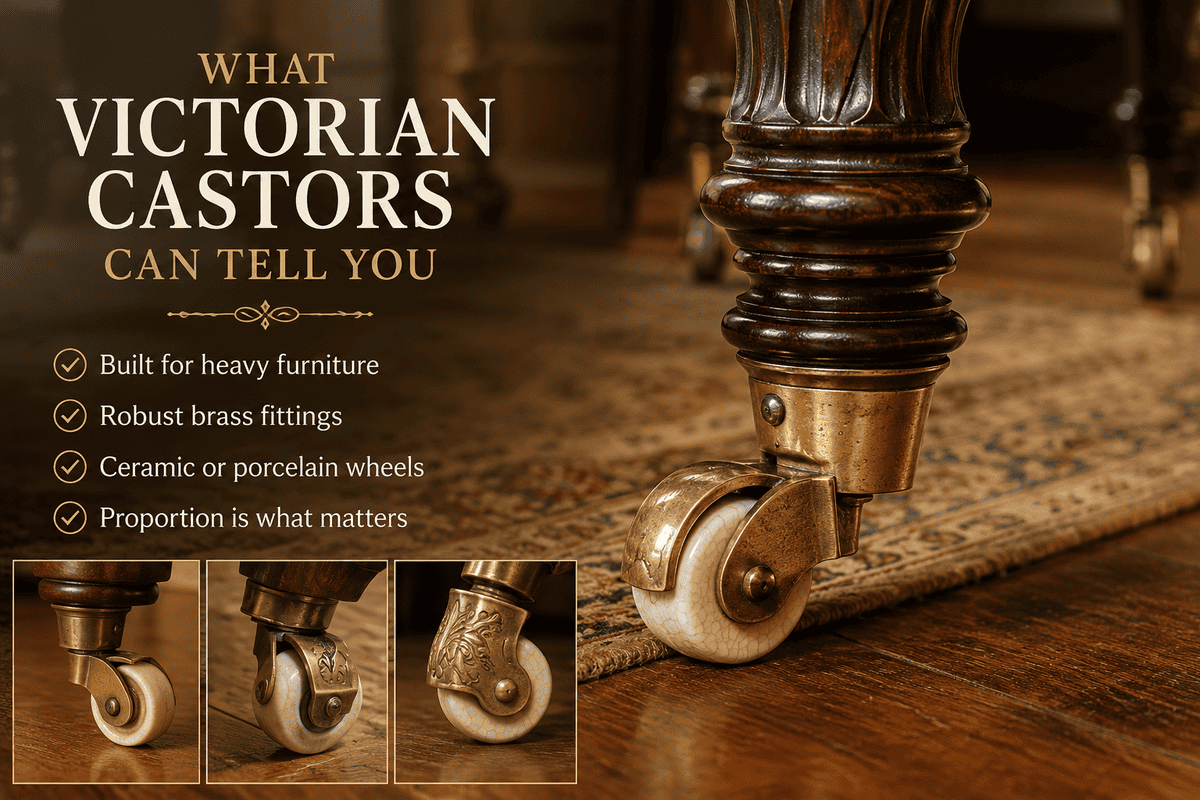
Victorian furniture can be remarkably substantial. A deeply upholstered armchair, large dining table or heavy sofa needed castors capable of carrying considerable weight while still allowing servants or householders to move it.
Consequently, nineteenth-century furniture often carries robust brass castors, while ceramic and porcelain wheels also appear regularly. Some are fitted into brass sockets or forks, creating a surprisingly substantial piece of engineering beneath an otherwise decorative chair or table.
Size alone does not provide a date, however. The important point is proportion. A large castor beneath a heavy Victorian leg can look completely natural because the two were designed to work together.
Edwardian Furniture Often Became More Delicate
As furniture became lighter in appearance around the turn of the twentieth century, the hardware often followed. Many Edwardian occasional tables, chairs and drawing-room pieces stand on slimmer legs, so large Victorian-style castors would have looked clumsy beneath them.
Where makers fitted castors, small all-brass examples are frequently encountered. Some sit so discreetly beneath the foot that they are barely noticeable until the furniture is turned over.
This relationship between the leg and its castor can be more useful than the material of the wheel itself. Hardware should make visual and practical sense for the furniture carrying it.
The Problem With Using Castors to Date Furniture
Castors are useful evidence, but they are also one of the easiest features to misread.
They wear out. They seize. Wheels break, sockets loosen and householders remove them when they damage floors. During more than a century of use, a perfectly genuine Victorian chair might acquire Edwardian or twentieth-century replacements, while somebody restoring an Edwardian table may fit reproduction castors in an earlier style.
That is why the timber around the fitting deserves as much attention as the castor itself.
Look for redundant screw holes, fresh-looking screws beside much older metal, compressed timber from an earlier fitting or a castor plate that does not quite cover the marks left by its predecessor. Uneven wear can also be revealing. An apparently ancient castor surrounded by recently disturbed timber should immediately make you look more closely.
Original fittings often seem to have grown old with the furniture. The metal, screws, timber and accumulated wear make sense together. Replacements can be perfectly serviceable and do not necessarily reduce the appeal of a piece, but recognising them prevents a later fitting from becoming false evidence for an earlier date.
The same principle applies to hinges, handles and locks. When examining Victorian vs Edwardian furniture, the underside and interior can sometimes tell you more than the beautifully polished surfaces everyone else has been looking at.
Four Clues to Check When Comparing Victorian and Edwardian Furniture
If you have an unidentified piece standing in front of you, these four areas provide a useful starting point. None proves the date on its own, but together they can quickly show which period deserves closer investigation.
Overall Proportions
Victorian furniture often appears substantial, with heavier frames, deeper upholstery and stronger visual weight. Edwardian furniture frequently uses slimmer proportions and more open designs, particularly in drawing-room and occasional furniture.
Decoration and Inlay
Deep carving and pronounced mouldings appear frequently on Victorian furniture. Edwardian makers often favoured finer decorative work, including contrasting stringing, delicate marquetry and neoclassical motifs such as ribbons, swags, urns and bows.
Legs and Castors
Look beneath the furniture as well as at it. Victorian pieces often use more substantial legs and larger brass, ceramic or porcelain castors, while many Edwardian designs feature slimmer legs and smaller, less conspicuous castors.
Construction and Hardware
Examine drawers, backs, hinges, handles and fixing points. Construction should suit the proposed age, while redundant screw holes, disturbed timber or mismatched fittings may reveal later alterations that could otherwise mislead your identification.
Handles, Hinges and Screws Can Tell Their Own Story
Furniture hardware deserves more attention than it usually receives.
Original handles should normally look comfortable on the piece. Their scale, shape, wear and fixing points should make sense alongside the design of the furniture.
Look inside drawers and doors for evidence of previous fittings. Extra holes are an immediate clue that handles have been changed. A bright modern screw surrounded by century-old timber obviously deserves investigation, although one replacement screw certainly does not make an entire piece a reproduction.
Hinges can be equally informative. Examine how they have been fitted, whether the recesses appear original and whether wear corresponds with the surrounding wood.
Furniture lives complicated lives. Handles break, locks fail and hinges are repaired. The objective is not necessarily to find an untouched museum piece, but to understand what remains original and what has happened since it left the workshop.
Upholstery: Useful, but Do Not Trust the Fabric
Upholstered furniture provides some of the most dramatic visual differences between Victorian and Edwardian interiors, but the fabric you see today may tell you almost nothing about the date of the chair beneath it.
Victorian upholstery often favoured rich colour, deep buttoning, fringes and substantial padded forms. Horsehair, springs and traditional webbing formed part of increasingly sophisticated nineteenth-century upholstery techniques.
Edwardian chairs and sofas frequently became visually lighter. Floral fabrics, damasks and elegant drawing-room upholstery complemented the more delicate furniture beneath.
However, a chair made in 1870 may have been reupholstered in 1905, 1950 and again in 1995.
When possible, look beneath rather than judging the visible covering. The frame, tack holes, webbing arrangements, springs and evidence of previous upholstery can tell a much longer story than the latest fabric.
Construction: Where Style Gives Way to Evidence
Decoration tells us what a piece of furniture was intended to look like. Construction takes us behind the appearance and shows how somebody actually made it.
This is why I rarely examine an unfamiliar chest, cabinet or table without looking somewhere its maker never expected to be on display. Pull out a drawer. Look underneath the top. Examine the back boards. Open the cupboard and inspect the inside corners. These less glamorous areas often reveal considerably more than the polished front.
Start With the Drawers
A drawer gives you several clues at once. Examine the dovetails joining the front to the sides, but do not fall into the trap of assuming that anything neat must be modern.
Hand-cut dovetails can vary slightly in width and spacing, and earlier craftsmen often cut surprisingly fine joints. However, by the Victorian period furniture manufacture was becoming increasingly mechanised. Factories and larger workshops could produce extremely accurate components, while hand work continued alongside machinery.
Consequently, the difference between Victorian and Edwardian construction is not simply rough hand-cut joints versus perfect machine-made ones. Both periods produced furniture ranging from inexpensive mass-market pieces to exceptional cabinetmaking.
Look at the entire drawer instead. Does the construction make sense together? Examine the drawer bottom, the way it fits into the sides, the secondary timber used where appearance mattered less and the wear created by years of opening and closing.
Genuine age often reveals itself as a collection of small, consistent details rather than one spectacular clue.
Turn the Furniture Around
The back of a cabinet or chest can be even more revealing. Period furniture commonly used solid timber back boards, often in several sections rather than one perfectly uniform modern sheet. Saw marks, old nails, shrinkage and variations in the timber can all contribute to the story.
Likewise, look underneath tables and chairs. Tool marks and unfinished surfaces may survive there long after somebody has polished or restored the visible areas.
Modern sheet materials such as MDF clearly contradict a Victorian or Edwardian date when they form part of the original construction. Plywood requires more care, however. Early forms existed during the nineteenth century and became increasingly important around the turn of the twentieth century, so its presence deserves investigation rather than an automatic verdict of reproduction.
Look for Evidence of Change
Construction can also reveal what happened after somebody made the furniture.
Extra screw holes may show that a fitting has moved. New blocks beneath a chair can indicate strengthening. A replaced drawer runner may explain why one drawer feels different from the others. Fresh timber beside an old joint may reveal a perfectly sensible restoration rather than deception.
Repairs are part of the history of antique furniture. A chair that has spent 130 years being sat on has every right to have needed attention somewhere along the way.
The important question is whether you can recognise what is original, what has changed and whether those alterations affect your interpretation of the piece.
When comparing Victorian vs Edwardian furniture, construction rarely gives you a convenient date stamped underneath. Instead, it helps you decide whether the age suggested by the style is supported by the physical evidence.
Why Victorian and Edwardian Furniture Look Different
It is tempting to imagine Victorian furniture disappearing with Queen Victoria in January 1901 and a completely new Edwardian style arriving with the new king. Furniture history was never that tidy.
The change had already begun decades earlier.
Victorian Britain experienced extraordinary industrial, economic and social change. Furniture that once depended heavily on individual craftsmen could increasingly be produced in factories and workshops using mechanised processes. Meanwhile, a growing middle class wanted comfortable, fashionable homes and manufacturers became remarkably good at supplying them.
The result was not one single Victorian style but many.
Gothic Revival furniture borrowed pointed arches and architectural forms from the medieval past. Rococo Revival designs returned to curves and exuberant ornament. Renaissance and classical influences appeared elsewhere, while manufacturers could reinterpret fashionable historical styles at different price levels for an expanding domestic market.
The Victorian Interior Was Not Always Dark and Gloomy
Our modern picture of the Victorian home can become something of a caricature: dark mahogany, heavy curtains, patterned wallpaper and every available surface occupied by an ornament.
Such interiors certainly existed, particularly during parts of the mid and later nineteenth century. However, Queen Victoria reigned for more than sixty years. Taste changed repeatedly during that enormous span of time.
More importantly, Victorian designers themselves began questioning excessive ornament and poor-quality mass production long before the Edwardian period arrived.
The Rebellion Started During Victoria’s Reign
The Arts and Crafts movement championed craftsmanship, useful objects, natural materials and greater honesty in design. Figures associated with the movement objected to what they saw as the worst consequences of industrial manufacture and meaningless applied decoration.
The Victoria and Albert Museum’s Arts and Crafts collection provides useful background on the movement and its influence on British design.
At the same time, the Aesthetic Movement encouraged interiors in which beauty and artistic expression mattered for their own sake. Towards the end of the century, Art Nouveau introduced another visual language, using sinuous lines and forms inspired by flowers, stems and the natural world.
All of this was happening before Edward VII became king.
What Changed in the Edwardian Home?
By the early twentieth century, fashionable domestic interiors often sought a lighter atmosphere. Rooms could become less visually crowded, while furniture with finer proportions suited drawing rooms, bedrooms and increasingly informal domestic spaces.
There was also renewed enthusiasm for eighteenth-century English design. Makers borrowed freely from the elegant furniture associated with designers such as Sheraton and Hepplewhite. Slender legs, restrained proportions, satinwood, mahogany veneers, fine stringing and neoclassical decoration fitted this taste beautifully.
Yet Arts and Crafts furniture continued to be made, Art Nouveau remained influential and plenty of customers still bought traditional furniture.
That overlap matters enormously when identifying antiques today.
The difference between Victorian vs Edwardian furniture represents an evolution in taste rather than an overnight revolution. A piece made in 1898 can look surprisingly modern beside one made twenty years earlier, while furniture produced in 1905 may deliberately imitate a design from the eighteenth century.
Understanding that overlap prevents one of the easiest mistakes in furniture identification: trying to force every object neatly into the reign of the monarch who happened to occupy the throne when somebody made it.
The Biggest Mistake: Dating Furniture From One Feature
After examining timber, castors, decoration, construction and hardware, it becomes tempting to search for the one feature that will settle the argument.
Unfortunately, antique furniture rarely provides one.
Never rely on a single clue.
A porcelain castor does not automatically make a chair Victorian. Fine boxwood stringing does not automatically make a cabinet Edwardian. Dark mahogany proves neither age nor period, and an old brass handle may have spent only twenty years on a chest that is more than a century old.
Instead, look for agreement between the clues.
Build a Case Rather Than Looking for Proof
Imagine examining a mahogany occasional table. Its slender proportions suggest the early twentieth century. Fine stringing and restrained neoclassical decoration point in the same direction. Small brass castors look appropriate to the legs, while the underside, screws and construction show the sort of age you would expect.
No single feature proves that the table is Edwardian. Together, however, they build a convincing case.
Now imagine that exactly the same table has one large porcelain castor.
Should that single wheel overturn everything else you have observed?
Probably not. It should make you investigate the castor.
Look for different screw holes, altered timber or evidence that somebody fitted a replacement. If four independent clues suggest circa 1905 and one easily replaceable fitting suggests 1870, question the fitting before rewriting the history of the entire table.
Learn to Notice Contradictions
This works in the opposite direction too. A piece can look convincingly Victorian from across the room but reveal uncomfortable contradictions when examined closely.
Perhaps the carving looks right but the construction does not. Maybe apparently old handles conceal a second set of fixing holes. Perhaps the back consists of obviously modern material, or wear appears in places where genuine use should not have produced it.
One contradiction does not necessarily condemn a piece. It simply gives you a question that needs answering.
That is particularly important at auctions, antiques fairs and house clearances, where furniture may have accumulated restorations, replacements and alterations through several generations of ownership.
The aim is not to find furniture that nobody has touched since 1885. It is to understand what you are looking at.
This principle extends well beyond furniture. Good antique identification usually comes from several independent clues supporting one another rather than one apparently decisive feature. We use exactly the same approach in our guide to telling silver from silver plate, where marks, wear, construction and material all contribute to the identification.
With experience, this process becomes increasingly instinctive. You notice the overall style first, then start testing that impression against the evidence. When the proportions, timber, decoration, construction, hardware and wear all tell roughly the same story, you can begin to date a piece with considerably more confidence.
Victorian or Edwardian? A Practical First Inspection
When you next encounter an unidentified chair, table, cabinet or bureau, resist the temptation to search immediately for a maker’s label or concentrate on one impressive-looking detail. Begin with the furniture itself.
Give yourself a few minutes and examine it in a logical order. You are not looking for one feature that announces Victorian or Edwardian. You are building a picture from several pieces of evidence.
1. Stand Back Before You Touch It
Start with the overall proportions. Does the furniture feel substantial and visually heavy, or lighter and more restrained? Look at the relationship between the top, body, legs and feet rather than concentrating on decoration.
A large Victorian dining table or upholstered chair may immediately communicate weight and solidity. An Edwardian occasional table or drawing-room chair may instead rely on slender legs and more open space. Neither observation proves a date, but it gives you a useful first impression to test.
2. Identify the Timber and How the Maker Used It
Move closer and examine the wood. Do not simply decide that dark timber means Victorian and lighter timber means Edwardian.
Look for solid timber, veneers, contrasting banding and stringing. Examine the grain where possible. Mahogany appears extensively in both periods, so ask how the maker used it. Heavy carving and broad mouldings create a very different effect from a fine mahogany veneer edged with delicate boxwood stringing.
Look inside drawers and behind fittings for protected areas that may reveal how much the visible surface has darkened with age.
3. Read the Decoration
Now examine the decorative vocabulary. Is the furniture dominated by carving, turned elements and pronounced mouldings, or does it rely more heavily on fine inlay and restrained detail?
On Edwardian revival furniture, look particularly for stringing, marquetry and neoclassical motifs such as swags, urns, ribbons, bows and bellflowers. On Victorian furniture, remember that several revival styles existed, so Gothic, Rococo, Renaissance and classical influences can all appear.
Decoration should support your first impression, not replace it.
4. Follow the Legs Down to the Floor
Legs and feet can reveal changes in proportion particularly clearly. Examine whether they are heavy, turned or boldly carved, or slender, tapered and comparatively restrained.
Then look at the castors, if present. Large brass, ceramic or porcelain castors may support a Victorian attribution, while smaller discreet brass castors can suit lighter Edwardian furniture.
However, immediately ask the second question: are they original?
Look for redundant fixing holes, disturbed timber, mismatched screws and fittings that appear too large or too small for the leg carrying them.
5. Open the Drawers
If the furniture has drawers, remove one carefully and examine it from every side.
Look at the dovetails, drawer bottom, runners and secondary timbers. Check whether wear underneath corresponds with long use. Slight variations in hand finishing can be informative, but remember that Victorian furniture manufacture already used machinery extensively. Neat workmanship does not automatically mean modern.
Also inspect the back of the drawer front. Extra holes may reveal replacement handles even when the fittings on the front look convincingly old.
6. Look at the Back and Underneath
This is where an apparently impressive antique can become much more interesting.
The back of a cabinet, underside of a table and interior of a cupboard often escape the repeated polishing and restoration applied to visible surfaces. Look at the boards, joints, nails, screws, tool marks and unfinished timber.
You are looking for consistency. Does everything appear to have aged together, or does one section look unexpectedly fresh?
Repairs are not automatically a problem. What matters is recognising them so that a twentieth-century alteration does not become evidence for a nineteenth-century date.
7. Check Upholstery With Caution
If you are examining a chair or sofa, treat the visible fabric as one of the least reliable dating clues. Upholstery wears out and owners replace it.
Instead, where inspection is possible without causing damage, look beneath the seat. Earlier tack holes, webbing, springs, stuffing and alterations to the frame may reveal several generations of upholstery.
A Victorian chair wearing modern fabric remains a Victorian chair.
8. Only Now Look for Labels, Stamps and Marks
Once you have formed an opinion from the furniture itself, search for a maker’s stamp, retailer’s label, registration mark, inventory number or handwritten notation.
A genuine label can be extremely useful, particularly when it identifies a known manufacturer or retailer. However, do not allow a label to override contradictory physical evidence without investigating further.
Retailer’s labels are especially interesting because the company named on them did not necessarily manufacture the furniture. A retailer may have sold furniture supplied by several different makers.
9. Ask Whether Everything Agrees
Finally, stand back again and review what you have found.
Suppose the proportions suggest Edwardian furniture, the mahogany carries fine boxwood stringing, the legs are slender, the castors are small brass examples and the construction looks consistent with the beginning of the twentieth century. You now have several independent clues pointing in approximately the same direction.
If one handle looks Victorian, investigate the handle.
If half the evidence suggests 1870 and the other half suggests 1910, do not force an answer. You may be looking at a transitional design, revival furniture, substantial later alterations or simply a piece that needs further research.
Knowing when the evidence is inconclusive is part of identifying antique furniture properly.
That is the real value of a first inspection. You may not leave knowing the exact year somebody made the furniture, but you should leave knowing considerably more about what it is, what has happened to it and which clues deserve further investigation.
If you would like a reference to keep nearby while examining furniture, Trevor Yorke’s How to Date Furniture: An Easy Reference Guide is a particularly useful companion. It covers different furniture types, changing woods and styles, important dating details and reproductions, making it well suited to the sort of practical identification described in this guide.
Frequently Asked Questions About Victorian vs Edwardian Furniture
That process will not turn every piece into an easy identification. Transitional furniture, revival styles and later reproductions can challenge experienced dealers as well as beginners. However, it is considerably more reliable than trying to date furniture from colour, fashion or a single decorative feature.
Victorian vs Edwardian Furniture: The Difference in a Nutshell
Most Victorian vs Edwardian furniture is best distinguished by looking at the complete object rather than searching for one decisive clue. Victorian furniture covers an exceptionally broad range of styles, but many familiar examples favour substantial construction, richer carving, deeper upholstery and strong proportions. Edwardian furniture often appears lighter and more refined, with slender forms, delicate veneers, stringing, marquetry and renewed enthusiasm for Georgian and neoclassical design.
The dividing line, however, is blurred.
The best way to distinguish Victorian vs Edwardian furniture is therefore not to memorise a checklist of supposedly exclusive features. Learn what each period generally favoured, then examine the entire object for evidence that supports — or contradicts — that first impression.
After handling enough furniture, something interesting begins to happen. You stop seeing isolated castors, legs and handles and start seeing how they belong together. That is when dating furniture becomes less about remembering rules and more about understanding the object standing in front of you.
Affiliate disclosure: Antiques & Homes may earn a small commission from qualifying purchases made through links in this article, at no extra cost to you. We only recommend products we believe may be genuinely useful to collectors.
