

You pick up a colourful glass vase at a car boot sale, charity shop or auction. It feels beautifully made, the colours are striking and someone has taken the trouble to polish the base. Then somebody says the magic word: Murano. But is it Murano, and how can you actually tell?
It is one of the questions I hear most often around vintage and collectable glass, yet unfortunately there is no single test that provides the answer. Genuine Murano glass can be heavy or remarkably light, brightly coloured or restrained, labelled or completely unmarked. It may contain bubbles, coloured layers, gold inclusions, canes or none of these things at all.
Meanwhile, glassmakers in other parts of Italy, Czechoslovakia, Scandinavia, Britain and elsewhere produced excellent decorative glass that shares some of the same characteristics. Over the years, countless perfectly good pieces have acquired a Murano attribution simply because nobody knew what else to call them.
Quick Answer: Is It Murano?
No single feature proves that a vintage piece came from Murano. A polished base, pontil mark, controlled bubbles, sommerso colours, aventurine or substantial weight may all form part of the evidence, but none proves origin by itself. To decide whether a piece is Murano, examine its shape, technique, colour, construction, finish, base, age, labels or signatures and, whenever possible, compare it with documented examples from known Murano furnaces.
The most important lesson is simple: Murano is an origin, not a style. Genuine Murano glass comes from the island of Murano in the Venetian lagoon. The name does not describe every colourful piece of Italian art glass, nor does it cover every object that uses a technique associated with Murano.
Why So Much Glass Gets Misidentified
Part of the problem comes from Murano’s extraordinary influence. Its glassmakers developed, revived and refined techniques that inspired factories and designers throughout Europe. During the twentieth century, particularly after the Second World War, colourful art glass became enormously fashionable, and manufacturers across Europe created their own interpretations of contemporary decorative glass.
There is another complication. A great deal of genuine vintage Murano glass never received a permanent signature. Some pieces originally carried paper or foil labels that disappeared after years of washing, handling and use. Consequently, finding an attractive unmarked vase today is perfectly normal, whether it came from Murano or somewhere else.
The antiques trade adds another problem. Once people repeat an attribution often enough, it can begin to look like a fact. One seller describes an unidentified layered vase as Murano, another copies the description, and eventually several apparently identical examples online seem to confirm one another. Unfortunately, ten listings repeating the same attribution do not constitute ten independent pieces of evidence.
Murano Is a Place, Not a Style
Murano is an island within Venice with a glassmaking tradition stretching back centuries. Venetian glassmaking itself is considerably older, while generations of specialist furnaces, master glassmakers, designers and craftsmen turned Murano into the celebrated glassmaking centre we know today.
The Museo del Vetro, the official Glass Museum on Murano, holds an extensive collection documenting this history. Its twentieth-century collection alone demonstrates just how misleading the idea of a single recognisable “Murano look” can be.
Factories including Venini, Seguso Vetri d’Arte, AVEM and Salviati created remarkably different glass, while designers and glassmakers continually experimented with colour, form and technique. Heavy sculptural pieces existed alongside exceptionally delicate blown glass. Some designs relied on dramatic layers of colour, whereas others depended upon filigree, murrine, engraving, surface texture or beautifully simple forms.
Therefore, asking whether something “looks Murano” is only the beginning of an identification, never the end of it.
Start by Looking at the Whole Object
When I pick up an unidentified piece of glass, I do not immediately turn it over and search for one magic clue. I look at the whole object first. Does the shape make sense for the period it supposedly comes from? How has the maker introduced the colour? Is the piece blown, moulded, cased or worked from solid glass? Do the applied elements show skill and confidence, and does the base make sense alongside the rest of the workmanship?
This broader approach matters because individual features are remarkably easy to misinterpret. A polished pontil may tell you something about how the glassmaker finished a piece, but it cannot tell you where the workshop stood. Likewise, a beautifully polished base demonstrates care in finishing; factories outside Murano were perfectly capable of polishing glass.
If you are unsure how an object itself was formed, our guide to pressed glass vs blown glass explains some of the basic manufacturing clues worth examining before attempting a more specific attribution.
Quality Matters, but Perfection Does Not
Good Murano glass often reveals considerable skill when you handle it. Curves tend to look intentional, applied elements show confident workmanship and colours may have impressive clarity and depth. On a sophisticated piece, several difficult processes can appear effortless because the glassmaker knew precisely how the hot glass would behave.
However, “handmade” does not mean mathematically perfect. Genuine hand-worked glass can show small variations, occasional bubbles and slight asymmetry. Conversely, imperfections do not prove that an object is old or Murano, because modern decorative glass can contain bubbles and irregularities too.
Quality is something you assess across the whole piece. The balance of the form, control of the glass, finishing and complexity of construction tell you far more than hunting for a convenient imperfection that supposedly proves hand manufacture.
What Does the Base Really Tell You?
The polished base is probably one of the most persistent shortcuts in online glass identification. Many quality Murano pieces do indeed have beautifully finished bases. Depending on the object and its method of manufacture, you may find a ground and polished pontil area, a broad polished base, evidence of cold working or other careful finishing.
Those details certainly deserve attention, but skilled glassmakers throughout Europe used grinding and polishing techniques. Scandinavian and Czech glass in particular can have superbly finished bases, while other Italian producers also used extensive cold working. A polished base tells you that somebody took time to finish the object; it does not provide their address.
The same principle applies to a pontil mark. When a glassmaker works a blown object using a pontil rod, separating the finished piece can leave a scar on the base. The maker may leave it rough, grind part of it away or polish it carefully, and that treatment can tell us something about the manufacturing process. Glassmakers in many countries have used pontil rods for centuries, however, so a pontil mark by itself cannot answer the question is it Murano.
Sommerso: One of the Biggest Murano Traps
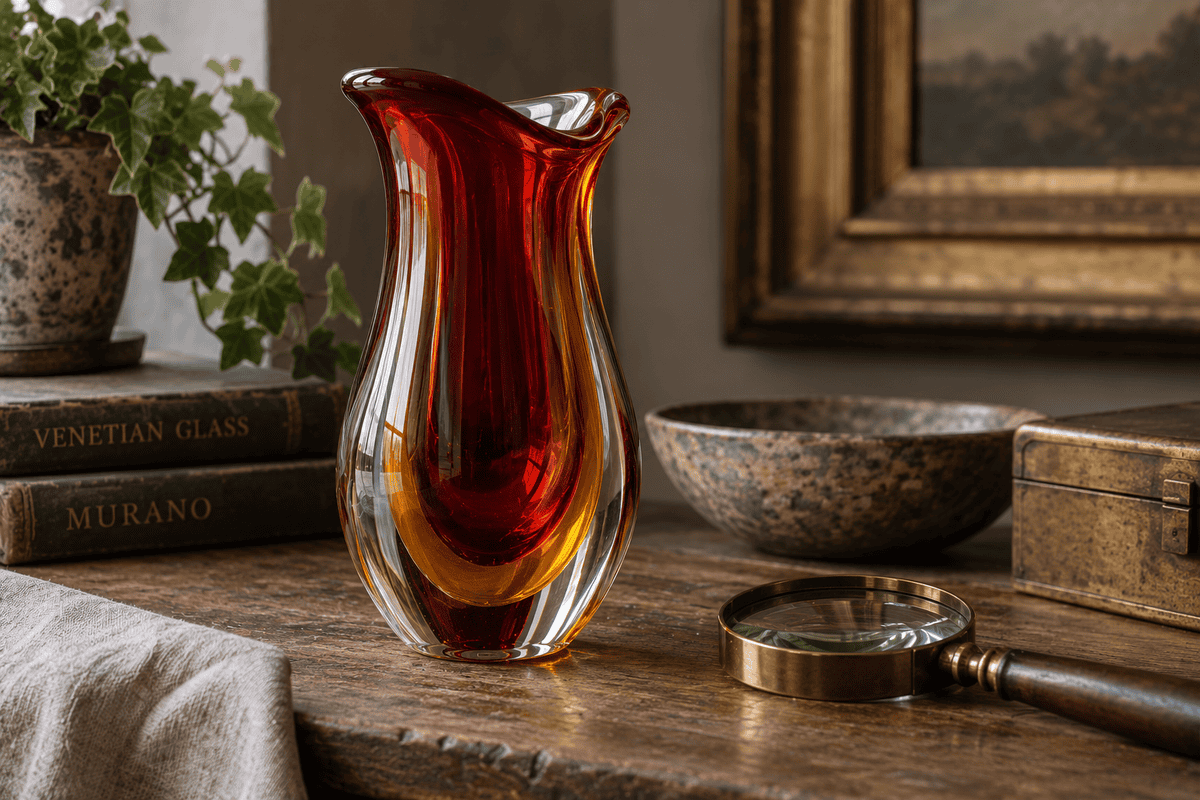
Sommerso is one of the techniques most strongly associated with twentieth-century Murano, and it is also responsible for an enormous number of optimistic attributions. The Italian word sommerso means submerged, and in glassmaking the term describes layers of differently coloured glass encased one within another, often beneath an outer layer of clear glass.
Looking through a good sommerso piece can reveal remarkably distinct bands or zones of colour that appear suspended within the object. The technique has an important place in Murano history, and the Murano Glass Museum documents both the development of heavy glass during the mid twentieth century and the celebrated layered work associated with Flavio Poli and Seguso Vetri d’Arte.
That association does not mean every sommerso vase is by Flavio Poli, Seguso or even necessarily Murano. Numerous Murano furnaces produced layered glass, while glassmakers elsewhere explored visually related techniques. If you want to attribute a piece to a particular designer, you need considerably stronger evidence, ideally a documented model, reliable label, signature, catalogue reference or convincing provenance.
In other words, “sommerso” describes a technique. It is not the name of a manufacturer.
Bubbles, Canes and Sparkling Glass
Controlled bubbles create another classic identification trap. Murano makers certainly used deliberate bubble effects, often described in Italian glass terminology as bullicante, and some spectacular examples survive. Yet Murano glassmakers never held a monopoly on the idea.
British and other European glassmakers also arranged bubbles deliberately, while paperweight makers used the effect extensively. Our guide to controlled bubble paperweights looks more closely at deliberate bubble patterns and the accidental bubbles that can become trapped during manufacture. If a seller’s entire Murano attribution consists of “it has controlled bubbles”, more work is needed.
Millefiori, murrine, aventurine and elaborate cane work can also point an investigation towards Venice for perfectly sensible reasons. These techniques have important connections with Murano’s glassmaking history, and the Murano Glass Museum documents the revival and development of murrine and millefiori work. Nevertheless, other glassmakers have produced related effects, so recognising a familiar technique should encourage further investigation rather than bring it to an end.
Labels Can Be Excellent Evidence
An original factory label can transform an identification. Labels from known makers such as Venini, Seguso, Barovier & Toso and other Murano firms can provide extremely useful evidence, particularly when the label type, object and period agree with one another.
Unfortunately, labels create their own problems. Manufacturers never intended most original paper labels to survive for seventy years, so their absence on vintage glass is hardly surprising. People can also transfer labels from one object to another, reproduction labels exist, and a generic label containing the word “Murano” does not necessarily carry the same weight as a documented manufacturer’s label.
Instead of seeing the word Murano and stopping there, read exactly what the label says. Does it name a furnace? Does its design correspond with documented labels from that company and period? In your mind, does the object resemble known production from the maker, and does the condition of the label make sense alongside the age and wear of the glass?
What About Fake Murano Labels?
Unfortunately, a Murano label is not automatically proof that the glass beneath it came from Murano. Reproduction labels exist, while genuine old labels can also be removed from one object and attached to another. There are also labels carrying Italian or Venetian-looking wording that may appear convincing without actually identifying a recognised Murano furnace.
This is why I never identify a piece from the label alone. Instead, I ask whether the label and the glass tell the same story. Does the shape correspond with documented work from that maker? Are the colours and techniques appropriate? Does the apparent age of the label make sense alongside the wear and condition of the object? A pristine-looking label on heavily worn vintage glass is not necessarily wrong, but it should encourage a closer look.
Details matter. Genuine historic labels varied enormously between furnaces and periods, so there is no universal Murano label to memorise. Lettering, logos, wording, printing quality and even the shape of a label can help when compared with documented examples. However, copying the appearance of an old paper or foil label is considerably easier than copying the glassmaking knowledge behind the object itself.
Equally, do not reject good glass simply because its original label has disappeared. Vintage labels were never intended to survive indefinitely, and decades of washing, handling and cleaning have removed many of them. An unlabelled piece with strong supporting evidence may be far more convincing than an ordinary piece carrying a questionable sticker.
Modern Certification and Vintage Glass
Modern buyers may encounter the official Vetro Artistico® Murano trademark. The Veneto Region established the protected mark in 1994 to identify qualifying artistic glass that authorised producers actually make on Murano. The scheme protects the geographical origin and helps consumers distinguish genuine contemporary Murano production from imitation.
It provides useful evidence when assessing modern glass, but we cannot apply it backwards to vintage objects. A vase made in 1955 obviously cannot carry a certification scheme created in 1994. Therefore, the absence of the modern trademark tells you nothing useful about whether an older piece genuinely came from Murano.
“Made in Italy” Is Not the Same as Murano
A genuine old “Made in Italy” label can provide valuable evidence, but it proves Italy rather than Murano. That distinction matters because Italy has other important glassmaking centres, particularly when we look at twentieth-century decorative glass.
Empoli in Tuscany, for example, became associated with an enormous variety of colourful bottles, decanters, vases and decorative forms. Some look surprisingly close to pieces that sellers routinely advertise as Murano. Empoli in Tuscany, for example, became associated with an enormous variety of colourful bottles, decanters, vases and decorative forms. “Is it Empoli?” deserves this identification guide of its own because exactly the same problem occurs in reverse: attractive Italian glass gets pushed into whichever famous geographical category seems most convenient.
When a genuine Made in Italy label unquestionably belongs to a piece, it narrows the search considerably. What it cannot do is narrow the origin all the way down to a small island in the Venetian lagoon.
The Furnaces and Designers Worth Knowing
Learning the names of the major furnaces is far more useful than memorising a list of supposed Murano characteristics. During the twentieth century, important names included Venini, Barovier & Toso, Seguso Vetri d’Arte, Archimede Seguso, AVEM, Salviati, Cenedese, Fratelli Toso and Aureliano Toso, among others.
Even those names illustrate the difficulty of attribution because the factories did not all make the same sort of glass. Venini became renowned for combining modern design with traditional techniques. Seguso Vetri d’Arte produced celebrated work associated with designers including Flavio Poli, while Archimede Seguso explored sophisticated filigree techniques. AVEM produced adventurous polychrome glass, whereas Salviati could create exceptionally light blown forms.
Designers moved between companies, fashions changed and furnaces experimented. Consequently, identifying a maker requires familiarity with documented forms and production rather than the belief that everything from a particular factory should carry one permanent visual signature.
There is also a considerable difference between saying “Murano”, identifying a known Murano furnace and attributing an object to a celebrated designer. Flavio Poli provides a perfect example. His name has become so closely connected with sommerso that sellers routinely advertise unidentified layered glass as “Flavio Poli”, yet the fact that Poli produced important sommerso designs clearly does not make every sommerso vase his work.
The same caution applies to Carlo Scarpa, Fulvio Bianconi, Dino Martens and other major figures. A valuable name should require better evidence, not lower the standard of proof. When you can match a form to a documented catalogue, museum example or reliable specialist reference, the attribution becomes much stronger. Without that evidence, “unattributed Murano” can be a considerably more knowledgeable description than an impressive designer name based on wishful thinking.
If you would like to explore the subject beyond identification, The History of Glass: A Journey Through the History of Murano Glass takes a broader look at Murano’s glassmaking tradition and makes a useful companion for anyone becoming seriously interested in Venetian glass.
Sometimes the Alternative Is Just as Interesting
Some of the hardest identification problems occur because the alternative to Murano is not cheap imitation glass at all. It may be excellent glass from another respected glassmaking tradition, which is one reason that deciding a piece is “not Murano” should never automatically feel disappointing.
Empoli and other Italian centres produced colourful mid-century vases, bottles and decanters that often acquire Murano attributions once their original labels disappear. Czech and former Czechoslovak factories employed highly accomplished designers and produced substantial, colourful and sculptural art glass. If you rely only on weight, colour and a polished base, some of it can look remarkably convincing as Italian glass.
Scandinavian makers add another layer of difficulty. Swedish, Danish and Finnish factories produced beautifully finished modernist glass, including cased and coloured forms with exceptional polishing. Britain has its own candidates too: Whitefriars and other makers produced hand-worked coloured glass and controlled bubble designs that occasionally become “Italian” somewhere between one owner and the next.
More recent decorative glass complicates the picture further because manufacturers around the world have adopted millefiori, layered colours, bubbles and Venetian-inspired forms. None of this makes those objects inferior. In fact, discovering that a supposed Murano vase is actually an interesting piece of Czech, Scandinavian, British or other Italian glass can make the identification considerably more satisfying.
Nine Common Clues and What They Really Mean
If you are standing at a fair, auction or car boot sale with a piece in your hand, these nine clues are worth remembering. None works as a magic Murano test, but together they can help you decide whether further investigation is worthwhile.
Notice what is missing from that list: a magic test. Identification becomes convincing when several independent clues begin pointing in the same direction.
How I Examine an Unidentified Piece
When I have an unidentified piece in front of me, I start with the form and construction rather than whatever happens to be written underneath. I look at the silhouette from several angles, consider the proportions and examine the rim, handles and applied decoration. Good natural light is particularly useful because it reveals how the maker built colours, layers and inclusions within the glass.
Only then do I turn the piece over. Base wear can help establish whether the object has genuinely spent years standing on a surface, while grinding, polishing, pontil scars and moulding provide clues to manufacture. Engraved or acid-etched marks deserve close examination, although an old scratch can become a surprisingly convincing “signature” once somebody desperately wants it to say Venini.
Any surviving label should stay exactly where it is while you photograph and research it. After that, comparison becomes much more important than speculation. Museum collections, original factory catalogues, respected specialist books and well-researched archives carry considerably more weight than marketplace listings that simply repeat unsupported attributions.
Eventually, the shape, construction, technique, finish, age and documentary evidence should begin to form a coherent picture. The strongest identifications rarely depend upon one spectacular clue; instead, several ordinary pieces of evidence agree with one another.
Knowing When the Evidence Runs Out
Sometimes an object has the quality, age, technique and general characteristics you would expect from Murano production, yet there simply is not enough evidence to identify its furnace. That is the point at which good identification requires restraint rather than imagination.
Descriptions such as “Italian art glass”, “possibly Murano” or simply “unidentified vintage art glass” can be perfectly respectable conclusions. Further research may eventually uncover a catalogue illustration, labelled comparison or documented example that changes the attribution, but until then there is little benefit in pretending certainty.
There is no shame in uncertainty. In fact, knowing where the evidence stops is one of the differences between identification and guesswork. The more specific the attribution becomes, the stronger the supporting evidence should become with it.
Frequently Asked Questions
Is all Murano glass signed?
No. Many genuine vintage pieces are unsigned. Some originally carried paper or foil labels that subsequently disappeared, while furnaces, periods and ranges followed different marking practices. An unsigned piece can therefore be genuine Murano, but the absence of a mark makes the other evidence more important.
Does a polished base mean a vase is Murano?
No. Many Murano pieces have beautifully ground and polished bases, but glassmakers elsewhere used the same finishing processes. Treat a polished base as one useful observation rather than proof of origin.
Is sommerso always Murano?
No. Sommerso is a layered glass technique particularly associated with Murano and important makers such as Seguso Vetri d’Arte, but glassmakers elsewhere have also produced layered and cased effects. Even when you can confidently identify a piece as Murano, the technique alone does not identify its furnace or designer.
Are bubbles a sign of genuine Murano glass?
Not by themselves. Deliberately arranged bubbles can form part of genuine Murano designs, while random bubbles may simply result from manufacture. Glass made outside Murano can also contain both deliberate and accidental bubbles.
Does a Made in Italy label prove Murano?
No. A genuine label supports Italian origin when it belongs to the object, but Italy has numerous glassmaking areas and manufacturers outside Murano. You need additional evidence before narrowing an attribution to the island.
Can genuine vintage Murano glass have no label?
Absolutely. Paper and foil labels can disappear remarkably easily over several decades. Washing, handling and ordinary use have removed countless original labels, so you should judge an unlabelled piece on the glass itself and compare it with documented examples.
How can I identify the maker of Murano glass?
Begin with any original label, signature or acid mark, then compare the form, technique, colours and construction with documented production from known furnaces. Original catalogues, museum collections and specialist reference works are particularly useful. Avoid assigning a famous designer merely because the technique resembles work associated with that person.
Final Thoughts: Is It Murano?
The question is it Murano sounds simple, but good glass identification rarely works through shortcuts. Murano’s furnaces produced such an extraordinary range of glass that no single colour, weight, pontil, bubble pattern or polished base can represent the whole island.
Instead, learn to read the object. Look at how the glassmaker made and finished it, then consider whether its shape and technique correspond with documented production. Check labels and signatures carefully, consider other possible manufacturers and resist the temptation to attach a famous name before the evidence supports it.
Sometimes the answer will be a confident yes. On other occasions another maker or country will emerge as a better fit, while occasionally the most accurate answer will remain “possibly Murano”. That uncertainty is not a failure. It is far better to own an interesting unidentified piece of good glass than an imaginary Flavio Poli.
Once you stop looking for a single Murano test and start considering the evidence as a whole, the question becomes much easier to approach — and learning why a piece is or is not Murano is often half the pleasure of collecting glass.
Affiliate disclosure: Some links in this article may be affiliate links. If you make a purchase through one of these links, Antiques & Homes may earn a small commission at no extra cost to you. This helps support the site and allows us to continue creating useful, independent articles about antiques, vintage pieces and collecting.
