
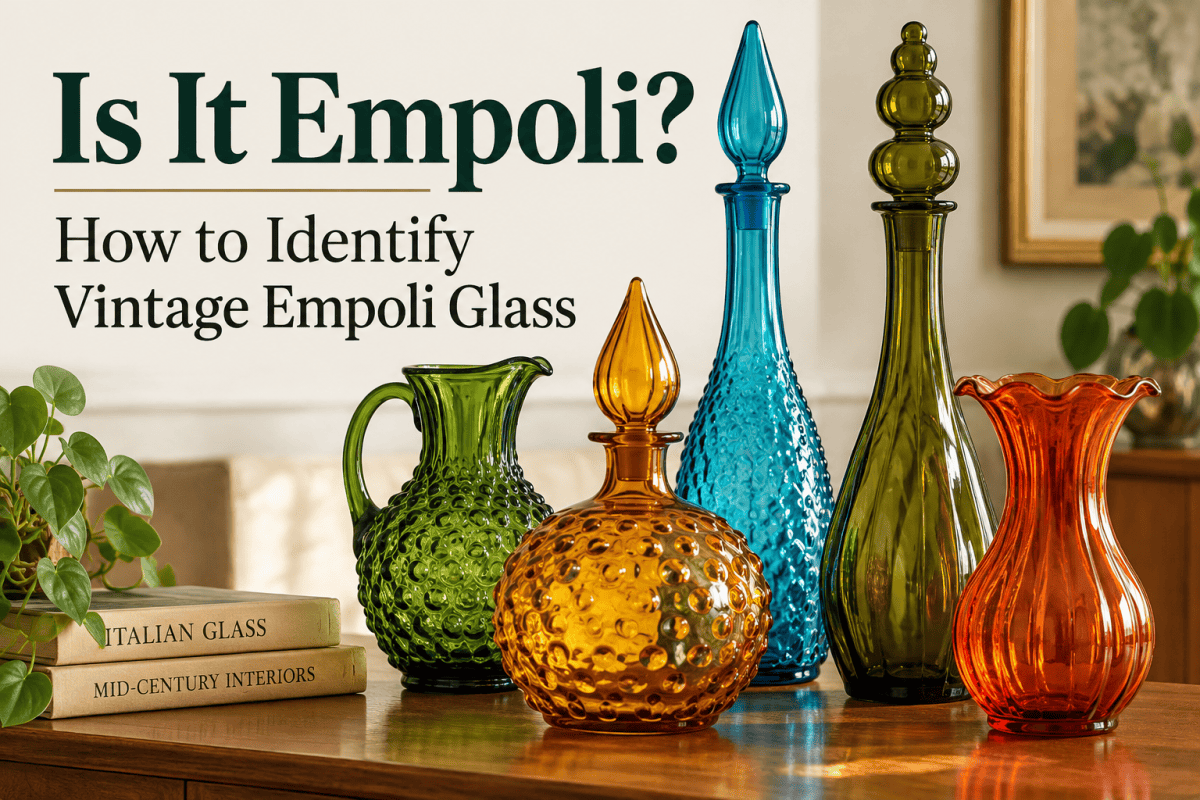
You pick up a tall green bottle at an antiques fair. It has an enormous stopper, an interesting textured surface and exactly the sort of shape that seems to belong in a 1960s interior. Search for something similar online and, before long, the word Empoli starts appearing. But is it Empoli, and what evidence can actually help you decide?
Vintage Empoli glass can be wonderfully distinctive, yet it is also surprisingly easy to misidentify. Green glass, large decorative stoppers, cased colours and dramatic bottle shapes are all associated with Empoli, but none proves an attribution on its own. In fact, one of the most useful things to understand from the beginning is that Empoli is a glassmaking centre, not a single manufacturer or a particular style.
Quick Answer: Is It Empoli?
There is no single test that proves a piece of vintage glass came from Empoli. Instead, examine its overall shape, colour, construction, manufacturing method, base, stopper, labels or marks and apparent age. Then compare those features with securely documented examples. A surviving factory label can provide particularly strong evidence, whereas colour or shape alone cannot.
Empoli is a town in Tuscany with a long glassmaking tradition, and numerous glassworks operated in the surrounding district. Consequently, the term Empoli glass covers a surprisingly broad range of production, from traditional green wine flasks and practical containers to colourful twentieth-century vases, bottles, tableware and decorative glass.
Therefore, when somebody asks is it Empoli, I prefer to turn the question around slightly. How much of the evidence actually points towards Empoli, and how much simply tells us that we have an attractive piece of vintage glass?
What Does Empoli Glass Actually Mean?
This is the first important distinction because Empoli is sometimes discussed online as though it were the name of a factory. It is not. Empoli is a Tuscan town and the centre of a wider glassmaking district in which numerous manufacturers operated.
That makes an Empoli attribution rather different from identifying a piece by a particular manufacturer. In some cases, evidence may allow us to say that an object is consistent with production from the Empoli area without knowing which glassworks actually made it. In others, a surviving label, documented design or reliable period reference may allow us to go considerably further.
It helps to think of attribution as a ladder. At the top we might have a documented manufacturer and model. Below that may be a convincing attribution to an Empoli glassworks or the wider Empoli district. Further down we might reasonably describe something as possibly Empoli, Italian glass or simply unattributed vintage glass.
Empoli Glass Began Long Before the 1950s
Collectors understandably associate Empoli with the colourful decorative glass of the mid-twentieth century. However, the area’s glassmaking story is considerably older.
The Empoli Glass Museum documents the town’s historic glass industry and preserves objects associated with local production. Official Tuscan sources also describe glassmaking as an important part of Empoli’s identity, particularly during the nineteenth and twentieth centuries.
It is worth being careful with some of the dates repeated online. Archaeologists have found evidence of glassmaking from the thirteenth century at Gambassi, south of Empoli, but we should not simply convert that into a claim that Empoli itself produced glass in the thirteenth century. The histories of the wider Tuscan glassmaking area and the town of Empoli are related, but they are not interchangeable.
From Wine Flasks to a Glassmaking Industry
Long before collectors became excited about huge decorative bottles in orange and purple, Empoli glassmaking had a much more practical purpose.
Wine production created demand for bottles, flasks and large containers. By the nineteenth century, the familiar green glass flask had become increasingly important both within Italy and for export. These utilitarian objects may not have been designed as glamorous pieces of art glass, but they established the manufacturing tradition from which later Empoli production developed.
The connection with wine also produced one of the most recognisable objects in Italian domestic culture: the straw-covered fiasco. Workers protected the glass with a covering made from dried marsh vegetation known as salicchio. Women who carried out this work, sometimes within factories and sometimes from their homes, became known as fiascaie.
It is a useful reminder that the history of glass is not only about designers and factories. It is also the history of ordinary working objects and the people who made them.
Why Is Traditional Empoli Glass Green?
Green is probably the colour most strongly associated with historic Empoli glass, and in this case there is a genuine reason behind the association.
The Empoli Glass Museum records early twentieth-century green flasks made by Vetreria Del Vivo and explains that their natural green colour resulted from the high proportion of ferrous oxide in the sand used to make the glass.
That gives green glass a legitimate place in the Empoli story. However, it does not give us a shortcut for identification.
Green glass was made in many places, while Empoli itself eventually produced glass in numerous other colours. Therefore, a green bottle may encourage you to investigate an Empoli attribution, but its colour cannot answer the question is it Empoli by itself.
From Green Bottles to Decorative Empoli Glass
Empoli’s production did not remain confined to practical wine containers. Decorative production became increasingly important, and official Tuscan material describes a particularly successful period between the two World Wars when local glassworks produced substantial quantities of decorative green glass.
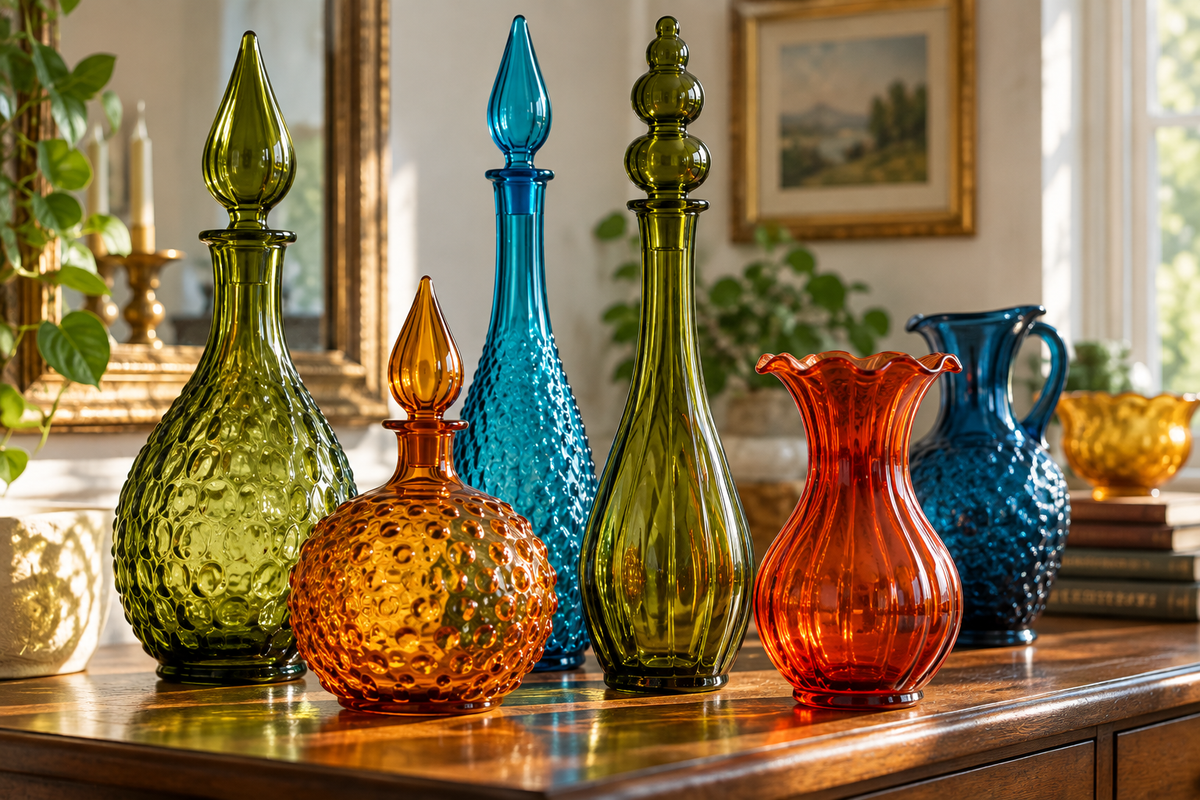
Later production became considerably more varied. Glassmakers expanded into coloured glass, clear glass, white glass, tableware and decorative forms, while the post-war appetite for modern interiors provided an ideal setting for bold glass vessels.
This helps explain why the phrase Empoli glass can produce such different images. To one collector it may mean traditional green glass. To another, it means a huge amber bottle with an extravagant stopper sitting on a teak sideboard.
Both belong within the wider story.
Empoli Glassworks Worth Knowing
Numerous glassworks operated in Empoli and the surrounding district, so memorising a long list of names is not particularly helpful for beginners. However, a few documented manufacturers demonstrate just how varied the production could be.
Vetreria Del Vivo
Vetreria Del Vivo is particularly useful because the Empoli Glass Museum holds examples of its work. Early twentieth-century green flasks from the glassworks illustrate the traditional blown-glass production that expanded alongside the wine trade.
These objects provide something extremely valuable when researching unidentified glass: a secure point of comparison rather than another modern seller’s attribution.
Vetreria Toso Bagnoli
At the other end of the decorative spectrum is a wonderful cat-shaped bottle by Vetreria Toso Bagnoli, which the museum dates to around 1960.
The cat has prominent upright ears, while thin applied glass filaments form details including its eyes, mouth and whiskers. Its curled tail becomes the handle. It is playful, decorative and unmistakably mid-century, while also demonstrating how far Empoli production had travelled from the humble wine flask.
Stelvia
Collectors of mid-century Italian glass will also encounter the name Stelvia, or S.T.E.L.V.I.A. Specialist glass references associate the company with the Empoli region during the post-war period and document colourful blown vases, jugs and tableware.
Stelvia is particularly interesting for identification because surviving labels provide evidence that can be compared with unmarked pieces. However, as with any manufacturer, resemblance is not enough to attribute an unlabelled vase to Stelvia. A documented comparison is far more persuasive than a similar shape found in an online listing.
Start by Looking at the Whole Object
When I pick up an unidentified piece of glass, I try not to decide what it is before I have properly looked at it. Once you begin with the thought that something must be Empoli, Murano or another desirable name, it becomes surprisingly easy to make every subsequent clue support the answer you already wanted.
Instead, start with the object itself.
What is it: a vase, bottle, decanter, jug, flask or piece of tableware? Is the shape balanced and deliberate? Does it appear blown, moulded or made using more than one technique? Is the glass transparent, opaque or cased? If there is a stopper, does it appear to belong with the bottle?
If you are unsure how the object itself was formed, our guide to pressed glass vs blown glass explains some of the manufacturing clues worth examining before attempting a more specific attribution.
Only after considering the whole object would I start concentrating on individual clues.
Shape Can Help, but It Cannot Prove Empoli
Many of the pieces collectors now associate with Empoli have strong silhouettes. Tall bottles, oversized decanters, elongated stoppers, textured vessels, large display pieces, jugs and colourful vases all appear within the collecting field.
A distinctive shape can certainly be useful. If you can match it with a securely documented factory example, catalogue image, period advertisement or correctly labelled comparison, the attribution becomes much stronger.
However, this is where internet identification can become dangerous. Finding a bottle online that looks exactly like yours does not necessarily prove that the description attached to it is correct. The first seller may simply have guessed, while subsequent sellers copied the attribution.
There is an additional complication: manufacturers outside Italy produced similar forms. Specialist glass research has documented decorative bottle designs associated with Italian production alongside extremely similar examples marked as made elsewhere, including Taiwan.
A matching shape is therefore a useful lead. It is not a certificate of origin.
Are Genie Bottles Empoli Glass?
Tall decorative bottles with elaborate stoppers are now widely called genie bottles by collectors. Many examples associated with the Empoli region date from the mid-twentieth century, particularly the 1960s and 1970s, and they have become one of the most recognisable forms in the collecting market.
Retailers sold some as decorative objects, while specialist research also records examples used for products such as wine and bubble bath. That perhaps makes them slightly less exotic than the modern name suggests, although “vintage bubble-bath bottle” admittedly lacks some of the magic.
More importantly, not every genie bottle is Empoli.
Some documented Italian examples came from moulds and may show seams, bubbles or relatively straightforward finishing. Therefore, a mould seam does not automatically rule out Empoli production. Equally, bubbles do not magically transform an ordinary bottle into hand-blown Italian art glass.
If your entire attribution rests on a large stopper and a dramatic silhouette, you need more evidence.
Colour: Is Green Glass Always Empoli?
No. Although traditional green glass has an important place in Empoli’s history, colour alone cannot establish origin.
Official Tuscan material records green alongside yellow and blue glass, while later decorative production introduced a much broader palette. Collectors consequently encounter glass attributed to the Empoli area in amber, orange, blue, green, white and other colours, as well as pieces combining several layers.
Colour is nevertheless useful when considered alongside other evidence. The particular combination of colour, form, construction and period may point an investigation in a sensible direction.
Problems arise when the reasoning runs backwards: it is green, therefore it is Empoli; it is colourful, therefore it is Murano. Neither conclusion is reliable.
Colour should support an attribution rather than create one.
What Does Cased Glass Tell You?
Cased glass appears frequently among twentieth-century decorative glass. Glassmakers could encase a coloured body within a clear outer layer, while some pieces also incorporate an opaque white layer beneath the colour. The resulting depth can be particularly striking when light passes through the object.
Several manufacturers associated with the Empoli area produced cased decorative glass, so the construction can certainly be consistent with an Empoli attribution.
However, casing is a glassmaking technique, not a geographical fingerprint. Italian manufacturers outside Empoli used it, as did glassmakers in Scandinavia, Czechoslovakia, Britain and elsewhere.
Therefore, identifying cased construction tells you something useful about how an object was made. It does not tell you where the furnace stood.
Turn It Over: What Does the Base Tell You?
The base is always worth examining, but there is no special “Empoli base” that provides an instant answer.
Look for mould seams, evidence of a pontil, grinding or polishing, moulded lettering, factory marks and genuine wear. Each can tell you something about manufacture or the object’s history.
A pontil scar may indicate part of the process used to make and finish a blown object, but glassmakers throughout the world used pontil rods. Similarly, a polished base demonstrates finishing, not geography.
Mould seams need equally careful interpretation. We know that factories in the Empoli region produced some decorative bottles in moulds, so the presence of a seam cannot automatically disqualify a piece.
Occasionally you may find raised or moulded Made in Italy wording. Assuming it is genuine and original to the object, that is useful evidence for Italian manufacture. What it does not do is narrow the origin from an entire country to Empoli.
Labels Can Transform an Identification
An original surviving label can provide one of the strongest identification clues, particularly when it names a known manufacturer rather than simply giving the country of origin.
Specialist label archives record several variations on glass associated with the Empoli district. Stelvia examples carry wording such as Made in Italy, Fatto a Mano, Lavorazione a Mano and Opalina Fiorentina. Labels associated with Vetreria Barbieri include V.B. Opaline Florence – Made in Italy.
However, labels require interpretation too.
A factory label that matches documented genuine examples may provide strong evidence. An importer or distributor label can establish part of an object’s commercial history without necessarily identifying the factory that made it. A generic Made in Italy label supports Italian origin if genuine, but it does not prove Empoli.
Meanwhile, the absence of a label proves remarkably little. Washing, cleaning and ordinary handling removed many paper and foil labels over the decades. Plenty of genuine vintage pieces have consequently reached us without the stickers they originally carried.
Can You Trust an Empoli Label?
A label deserves attention, but I would still examine the glass around it.
Does the shape correspond with documented production from the named manufacturer? Does the manufacturing method make sense? Do the colour, apparent age and wear agree with the attribution? Is the label actually naming a glassworks, or is it naming an importer or merely stating that the object came from Italy?
Someone can also remove a label from one object and place it on another. I would not suggest that every unusual label is fake, because that creates another identification myth. Instead, treat the label as one particularly useful piece of evidence and ask whether the rest of the object supports it.
A good label and a good piece of glass should tell the same story.
Nine Empoli Clues and What They Really Mean
If you are standing at an antiques fair, auction or car boot sale wondering is it Empoli, these nine clues provide a useful starting point. None works alone, but several agreeing with one another can make further investigation worthwhile.
Green Glass
Historically important to Empoli and worth investigating, but not proof of origin.
Tall Bottle or Decanter
A familiar form among collectable Empoli glass, although manufacturers elsewhere produced similar shapes.
Large Decorative Stopper
Strongly associated with the mid-century collecting market, but not geographical evidence by itself.
Cased Glass
Found in Empoli production, but also widely produced elsewhere.
Mould Seam
Does not automatically rule out Empoli because some documented decorative bottles came from moulds.
Pontil or Polished Base
Useful evidence about manufacture and finishing, but neither identifies the place of origin.
Made in Italy
Supports Italian manufacture when genuine, but does not establish Empoli.
Recognised Factory Label
Potentially strong evidence, particularly when the glass itself corresponds with documented production.
No Label
Common on vintage glass and neither proof for nor against an Empoli attribution.
Notice that there is no magic feature in that list. Identification becomes convincing when several independent observations begin to agree.
Empoli, Murano or Something Else?
This is where Italian glass identification becomes particularly interesting. Attractive coloured glass regularly moves between Empoli and Murano attributions online, sometimes with remarkably little evidence supporting either.
Empoli and Murano are different glassmaking centres with different histories. Both produced colourful twentieth-century decorative glass, and some individual techniques or visual characteristics overlap. That does not make the names interchangeable.
Murano is an island in the Venetian lagoon with its own network of furnaces and glassmaking traditions. Empoli developed within Tuscany from a strong utilitarian glass industry into a centre that also produced decorative glass.
If you are considering a Venetian attribution instead, our detailed guide Is It Murano? How to Identify Genuine Murano Glass explains the labels, bases, techniques and other evidence worth examining.
Nor are Murano and Empoli the only choices. Czech and Czechoslovak, Scandinavian, British and other Italian glass can share colours, shapes and techniques with pieces attributed to Empoli.
Discovering that a bottle is not Empoli does not make it a bad piece of glass. Sometimes finding the correct maker or country is considerably more interesting than keeping the famous attribution you started with.
Beware of Circular Internet Attributions
The internet has made comparing unidentified objects wonderfully easy, but it has also created a peculiar identification problem.
Imagine that somebody lists an unmarked green bottle and calls it Empoli because it looks vaguely Italian. Another seller finds the listing and repeats the attribution. Someone shares the image elsewhere, more examples appear, and search engines begin indexing the descriptions. Eventually, ten similar bottles all carry the Empoli name.
It looks like ten pieces of supporting evidence. In reality, all ten may descend from the same original guess.
Image-search tools can be extremely useful for finding comparable objects, but a visual match should begin your research rather than finish it. Whenever possible, follow an attribution backwards until you reach something stronger: a museum collection, original catalogue, period advertisement, genuine factory label or another securely documented example.
Useful Reference: Italian Glass by Leslie Piña
If you intend to identify or collect Italian glass seriously, a good reference book can be considerably more useful than comparing one online listing with another.
Italian Glass: Century 20 by Leslie Piña is a substantial illustrated reference covering Italian glass from 1900 to 2000, with particular attention to the highly collectable mid-century period. It includes around 700 colour photographs showing almost 1,000 examples, alongside company histories, designer biographies, techniques, a glossary and bibliography.
For anyone researching Empoli alongside Murano and other twentieth-century Italian glass, it provides the sort of documented comparison material that can help turn a visual resemblance into a more considered attribution.
View Italian Glass: Century 20 on Amazon UK →
How I Examine an Unidentified Piece of Glass
When I am trying to decide is it Empoli, I find it more useful to follow roughly the same process each time rather than hunt for one decisive clue.
First, I look at the whole object and decide what I can establish without giving it a name. I consider its shape, proportions, colour and likely function. Next, I examine how the maker formed it and look for evidence of free blowing, moulding, casing or applied elements.
After that comes the base. I look for seams, pontil evidence, grinding, polishing, moulded lettering and wear. If the object has a stopper, I examine that separately too. Does the colour correspond? Does it fit correctly? Do its construction and wear appear consistent with the bottle?
Next, I look for labels, signatures or marks. Rather than simply reading what a label says, I try to establish what sort of evidence it provides. A manufacturer’s label and a generic country-of-origin label are not the same thing.
Only then do I begin looking for comparisons. Museum collections and documented manufacturer examples come first. Period catalogues and advertising can be extremely useful, while reliable specialist references can help fill gaps that institutional collections do not cover.
Finally, I try to prove myself wrong.
If I think the piece is Empoli, could it actually be Murano? Perhaps it is Czech, Scandinavian, British or later imported glass. I also ask whether the supposed identifying feature is genuinely distinctive or whether I have simply seen it repeatedly attached to Empoli online.
Trying to disprove an attribution may sound slightly perverse, but it is one of the best ways to avoid seeing only the evidence you want to see.
When “Possibly Empoli” Is the Right Answer
Not every piece of vintage glass will surrender its identity, however long you stare at the base.
Labels disappear, manufacturers close, catalogues remain incomplete and different factories sometimes produced surprisingly similar objects. Consequently, you may find a piece whose age, form and construction are entirely consistent with Empoli production without having enough evidence to identify a particular factory.
In that situation, possibly Empoli may be exactly the right description.
Sometimes the evidence will only support Italian art glass. Occasionally even Italy cannot be established confidently, in which case unattributed vintage art glass is perfectly respectable.
The purpose of identification is not to attach the most impressive name possible. It is to find the explanation that best fits the evidence.
Frequently Asked Questions About Empoli Glass
What is Empoli glass?
Empoli glass is a broad term for glass produced in and around Empoli in Tuscany, Italy. Empoli is a glassmaking centre rather than a single manufacturer, and its production ranges from traditional green bottles and wine flasks to colourful twentieth-century decorative glass.
How can I tell if glass is Empoli?
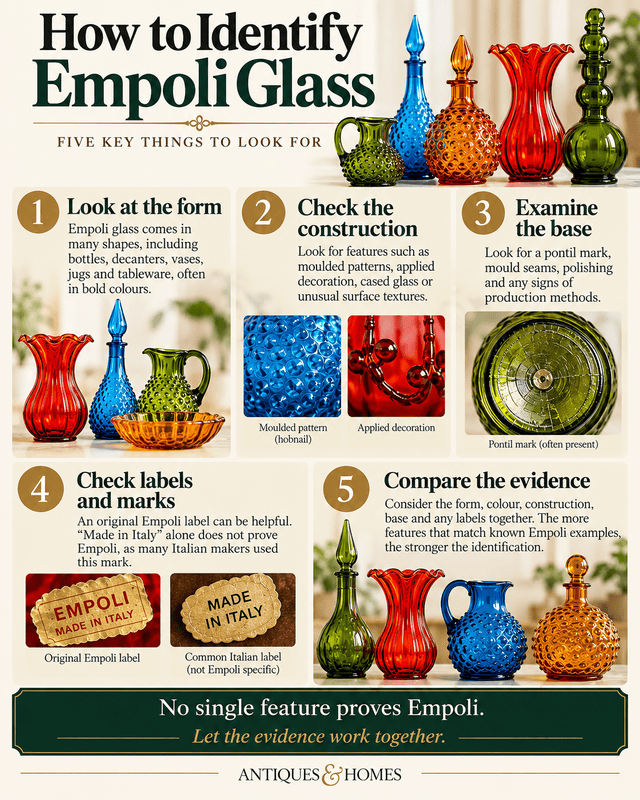
No single feature proves an Empoli origin. Examine the shape, colour, construction, manufacturing method, base, stopper, labels or marks and apparent age, then compare the piece with securely documented examples. A combination of independent clues provides much stronger evidence than colour or shape alone.
Is all green Italian glass Empoli?
Green glass has an important historical association with Empoli, but it is certainly not exclusive to the area. Glassmakers elsewhere in Italy and beyond also produced green glass, so treat the colour as a reason to investigate further rather than proof of origin.
Are all genie bottles Empoli?
Many decorative bottles now called genie bottles came from the Empoli region, particularly during the mid-twentieth century. However, manufacturers elsewhere produced similar forms, which means shape alone cannot establish where a bottle originated.
Does Made in Italy mean Empoli?
A genuine Made in Italy mark or label can provide useful evidence of Italian manufacture, but it does not identify Empoli or a particular Italian glassworks.
Is Empoli glass always hand blown?
Empoli’s glassmaking history includes a great deal of blown glass, but factories also produced mould-made decorative bottles. Therefore, finding a mould seam should not automatically rule out an Empoli attribution.
Is Empoli glass always marked or labelled?
Many vintage pieces have no surviving mark or label. Washing, cleaning and ordinary handling can remove paper and foil labels over the decades, so an original factory label can considerably strengthen an attribution while its absence proves very little.
Is Empoli the same as Murano?
Empoli and Murano are separate Italian glassmaking centres. Empoli lies in Tuscany, whereas Murano is an island in the Venetian lagoon. Both produced colourful decorative glass, but their histories, manufacturers and traditions are distinct.
Can I identify the exact Empoli glassworks?
Sometimes. A surviving factory label, documented model, catalogue image or securely attributed comparison may allow identification of a particular glassworks. However, many unmarked pieces cannot responsibly be attributed more precisely than Empoli-region glass, possibly Empoli or Italian art glass.
Final Thoughts: Is It Empoli?
The question is it Empoli sounds as though it should have a simple answer. Unfortunately, vintage glass rarely behaves quite so conveniently.
Empoli’s glassmakers produced an enormous variety of objects, from practical green wine flasks to exuberant decorative bottles and colourful mid-century glass. That variety is one of the reasons the subject is so interesting, but it also makes identification by colour or shape unreliable.
Instead, read the object. Look at how its maker formed and finished it. Examine the base and stopper, treat labels according to what they actually prove, and compare the piece with documented examples rather than relying on repeated marketplace descriptions.
Sometimes all of that evidence will lead to a confident Empoli attribution. Another manufacturer, region or country may provide a better explanation on other occasions. Sometimes the most accurate conclusion will remain possibly Empoli.
That uncertainty is not a failure. An honest question mark is considerably more useful than a famous attribution built on guesswork. Once you stop searching for a single Empoli test and start allowing several pieces of evidence to work together, identifying vintage glass becomes both more reliable and considerably more interesting.
Affiliate Disclosure: Some links in this article may be affiliate links. If you make a purchase through one of these links, Antiques & Homes may earn a small commission at no extra cost to you.
