
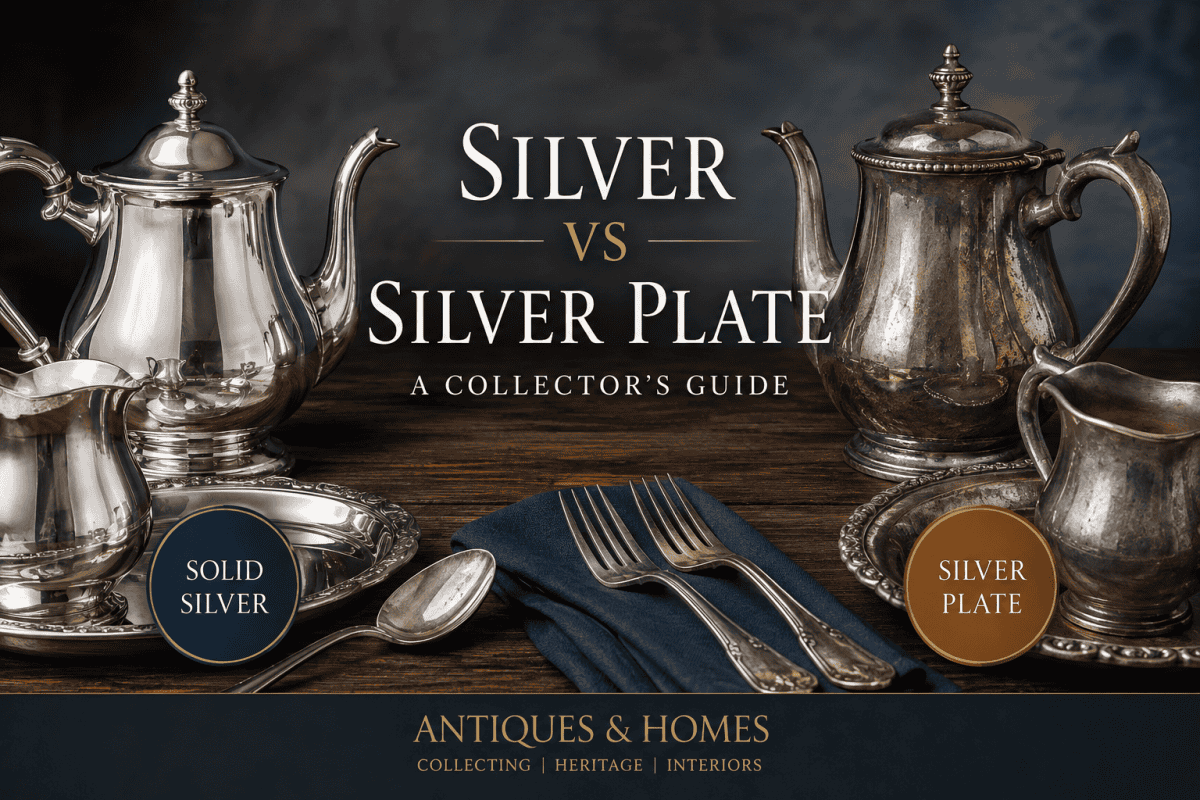
At almost every antiques fair, somebody eventually picks up a teapot, tray or piece of old cutlery amongst the silver and silver plate and asks the same question: “Is this solid silver?” Sometimes the answer appears immediately in a clear row of hallmarks. On other occasions, years of polishing, wear and accumulated tarnish make the truth far less obvious.
Silver and silver plate can look remarkably similar, particularly when a plated item has been well made and carefully looked after. However, they differ in construction, durability, value and the way they age. Learning to recognise those differences is one of the most useful skills a collector can develop.
This guide explains how to tell silver from silver plate using hallmarks, surface wear, colour, construction and a few practical dealer observations. It also looks at Old Sheffield Plate, common identification myths and the safest ways to care for both materials.
Quick Answer: What Is the Difference Between Silver and Silver Plate?
Solid silver contains silver throughout the item, usually in the form of sterling silver containing 92.5% pure silver. Silver plate consists of a base metal, such as copper, brass or nickel silver, covered with a thin layer of real silver. British sterling silver normally carries recognised hallmarks, while plated pieces often bear marks such as EP, EPNS, A1 or Silver Plate.
Why Silver and Silver Plate Are So Easily Confused
When newly polished and placed side by side, a sterling silver spoon and a good silver-plated spoon may appear almost identical. Both reflect light beautifully, both develop dark tarnish and both may carry impressed marks beneath their handles. The differences often reveal themselves only when you examine the marks and areas of wear closely.
Victorian and Edwardian manufacturers produced enormous quantities of plated tableware, ranging from modest domestic cutlery to elaborate centrepieces, tea services and hotel ware. Some pieces display exceptional craftsmanship. Manufacturers created silver plate so households could enjoy the appearance of fashionable silver without paying for precious metal throughout.
This is why the phrase “only silver plate” can be misleading. Silver plate has its own history, makers and collecting interest. A beautifully designed plated object may offer far more decorative appeal than an uninspiring piece of sterling silver, even though its intrinsic metal value remains lower.
What Counts as Solid Silver?
The term solid silver does not usually mean completely pure silver. Pure silver is soft and easily bent, so silversmiths combine it with a small proportion of another metal to create a stronger alloy.
In Britain, the standard most collectors encounter is sterling silver, which contains 925 parts silver per thousand. The remaining portion commonly consists of copper, giving the finished object enough strength for cutlery, jewellery, tableware and decorative objects.
Older British pieces may also appear in other recognised silver standards. Britannia silver, for example, has a higher silver content than sterling and carries its own fineness mark. Imported silver can follow different national standards, so an unfamiliar mark does not automatically mean an item is plated.
The important point is that a solid silver object contains silver throughout its main construction. If the surface becomes scratched or worn, the material beneath remains silver alloy rather than exposing a different-coloured base metal.
“The first question is not whether an object shines like silver. It is whether the marks and construction support the story it is telling.”
— Antiques & Homes Collector’s Advice
How British Silver Hallmarks Help
British hallmarking provides collectors with an unusually detailed identification system. A traditional hallmark can reveal the standard of silver, the person or company responsible for submitting the object, the assay office that tested it and, on many older pieces, the year in which it was assayed.
The lion passant is closely associated with sterling silver in England. Alongside it, you may find a sponsor’s or maker’s mark formed from initials inside a shaped punch. An assay office symbol identifies where the item was tested, while a date letter can help establish its age.
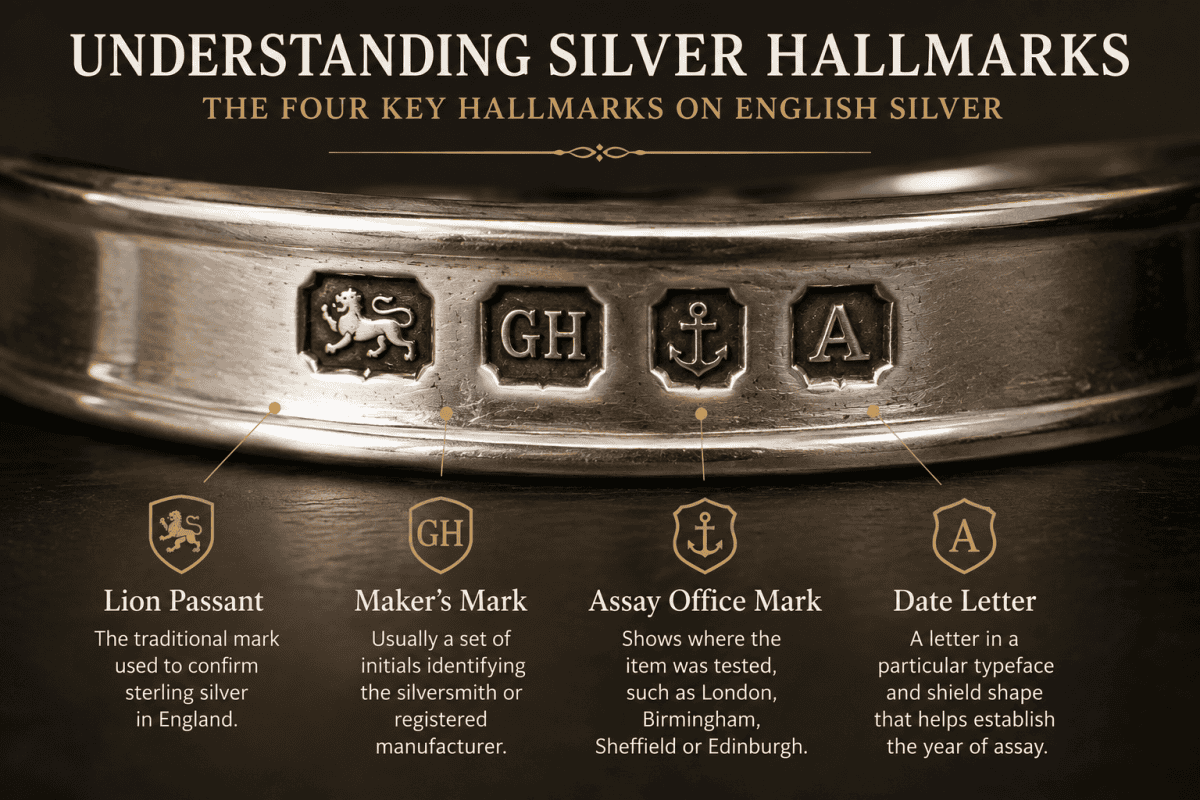
These marks are normally small and may appear beneath a base, inside a lid, around the rim of a bowl or on the reverse of a handle. Years of polishing can soften them considerably, so magnification and angled light often reveal details that remain invisible at first glance.
However, collectors should avoid assuming that every genuine silver object must carry a complete row of familiar British marks. Small items, imported pieces and certain older objects can follow different rules or bear alternative marks. Hallmarks should form part of the evidence rather than replacing careful examination altogether.
For an official explanation of British hallmarking and recognised symbols, consult the British Hallmarking Council’s consumer guidance.
Useful Tools for Examining Silver Hallmarks
Many collectors gradually build a small reference kit for examining antique metalware. One of the first tools worth owning is a good-quality illuminated jeweller’s loupe. Being able to magnify a worn hallmark, inspect tiny maker’s marks or examine areas where silver plate has begun to wear often makes the difference between making an informed purchase and simply guessing.
I rarely visit an antiques fair without one in my pocket. A compact 10× illuminated jeweller’s loupe offers clear magnification together with LED lighting, making it much easier to examine hallmarks, plating wear, stamps and other fine details, even in the variable lighting often found at fairs and auction viewing days.
As your interest grows, you’ll probably find yourself using a loupe on far more than silver. Coins, jewellery, ceramics, glass, stamps and many other antiques often reveal important clues that simply aren’t visible to the naked eye.
How Silver Plate Is Made
Silver plate uses real silver, but only as a surface coating. The main body of the object consists of another metal, commonly copper, brass, nickel silver or a similar alloy. Manufacturers then apply a thin layer of silver to create the familiar colour and finish.
Electroplating transformed the production of domestic metalware during the nineteenth century. It allowed manufacturers to coat complicated shapes consistently and produce matching services on a much larger scale. The result was an extraordinary range of affordable tableware that brought fashionable dining styles into far more homes.
A well-plated piece can remain attractive for generations. Problems arise when repeated polishing or constant handling gradually wears through the silver layer. The highest points usually reveal this first: rims, handles, decorative borders, feet and raised motifs endure more contact than recessed areas.
When the plate becomes thin, a warmer yellow, pink or grey colour may begin to appear beneath it. Copper often shows as a reddish warmth, brass tends towards yellow and nickel-based alloys can look colder and greyer.
Marks Commonly Found on Silver Plate
Plated objects do not carry British silver hallmarks confirming precious-metal fineness. Instead, manufacturers used a variety of trade descriptions and proprietary marks. Understanding these common abbreviations makes identifying silver plate much easier.
EP or EPNS
EP means Electroplate, while EPNS stands for Electro Plated Nickel Silver. Despite its name, nickel silver contains no precious silver until the outer silver coating is applied.
EPBM
Electro Plated Britannia Metal uses a base alloy, usually made from tin and antimony, before being coated with silver. It should never be confused with Britannia Silver, which is a recognised precious metal standard.
A1
A1 generally refers to the manufacturer’s grading of the silver plating quality. It is not a sterling silver hallmark and does not indicate the item is solid silver.
Silver Plate
Some makers simply stamped items with terms such as Silver Plate, Silver Plated or Electroplate. These marks describe the manufacturing process rather than the precious metal content.
Remember that manufacturers often arranged these marks in a row that resembles traditional hallmarks. For beginners this can be confusing, so always read the wording carefully rather than assuming every group of punches indicates solid silver.
How I Check Silver and Silver Plate
When examining an unfamiliar piece, I start with the marks but never stop there. The condition and construction often confirm what the stamp suggests, while occasionally exposing an incorrect description.
First, turn the object over and inspect the least visible areas. Makers usually placed marks beneath bases, behind handles or inside fittings. Use a loupe if necessary, but also change the angle of the light. A worn punch can suddenly become legible when light passes across rather than directly onto it.
Next, inspect the areas that receive the most handling. On cutlery, concentrate on the tips, shoulders and backs of bowls. On teapots, look around handles, finials, feet and rims. Trays and candlesticks usually have the most wear on the raised decoration and outer edges, and often reveal plate wear first.
Then consider the colour. Solid silver can tarnish heavily, yet a rubbed area should not expose a distinctly yellow or reddish metal beneath. Plated objects may show contrasting base metal where the silver coating has worn away.
Finally, study how the item was constructed. Some candlesticks, knife handles and decorative objects contain filling or non-silver components even when their outer sections are genuine silver. Weight alone therefore proves very little.
Why Weight Is Not a Reliable Test
Collectors often hear that solid silver feels heavier than plate. Although weight can contribute to an overall impression, it is not a dependable test by itself.
A substantial plated tray made over copper may feel extremely heavy. Conversely, a hand-raised silver bowl can feel surprisingly light because a skilled silversmith worked the metal into a thin, strong form. Candlesticks may also contain weighted bases, while knife handles can be hollow or filled.
The more useful question is whether the weight feels appropriate for the object’s method of construction. That judgement develops through handling many pieces rather than following a simple heavy-or-light rule.
Tarnish Does Not Prove an Item Is Sterling Silver
Another persistent myth suggests that black tarnish confirms solid silver. It does not. Because silver plate has genuine silver on its surface, it tarnishes in much the same way as sterling.
Likewise, a highly polished object should not automatically raise suspicion. Some owners polish their silver regularly, while others prefer a darker patina that emphasises engraved detail. Surface colour tells you about exposure and care, but rarely settles the question of construction on its own.
A magnet test also has limited value. Silver itself is not magnetic, yet many non-magnetic base metals are used beneath plating. A piece that does not attract a magnet is not necessarily solid silver. Meanwhile, steel components can appear within otherwise legitimate objects such as knife blades and mechanisms.
Old Sheffield Plate Is Not Ordinary Electroplate
One of the most interesting complications is Old Sheffield Plate. Developed before commercial electroplating became widespread, this material was produced by bonding silver to copper and rolling the metals together into sheets.
Manufacturers then shaped those sheets into trays, candlesticks, tea wares and decorative objects. The process required considerable skill, and good eighteenth- or early nineteenth-century examples now attract collectors in their own right.
Wear can reveal a copper core, particularly around edges and raised decoration. Makers sometimes disguised vulnerable areas with applied silver borders. On certain pieces, a visible line at an edge or seam can reveal the layered construction.
Old Sheffield Plate should not be dismissed as ordinary modern plate. Age, maker, design, rarity and condition can make individual pieces highly desirable, even though they do not contain solid silver throughout.
“Silver plate is not fake silver. It is a different material made for a different market, and the best examples deserve to be judged on craftsmanship rather than scrap value.”
— Antiques & Homes Collector’s Advice
Does Silver Plate Have Any Value?
Most ordinary plated cutlery and mass-produced tableware has little intrinsic metal value because the silver coating is extremely thin. However, that does not mean every plated object is worthless.
Collectors may pay for desirable makers, unusual forms, exceptional decoration or pieces linked to hotels, shipping lines, railways and historic institutions. Complete services in excellent condition can also attract interest, particularly when their design suits contemporary interiors.
Old Sheffield Plate occupies a separate collecting field, while later electroplate by respected designers and manufacturers may also command strong prices. As with many antiques, value rests on the complete object rather than the raw material alone.
Condition still matters. Extensive plate loss, deep scratching and clumsy repairs reduce appeal unless the item has unusual historical importance. Gentle wear can look attractive, but large exposed areas of base metal often make restoration uneconomic.
Is Solid Silver Always the Better Choice?
Solid silver offers obvious advantages. It has intrinsic precious-metal value, can survive generations of use and often carries hallmarks that turn identification into a miniature historical investigation. Collectors can research makers, assay offices and date letters, adding another layer of interest to the object.
However, silver plate may provide greater scale and decorative impact for the same budget. A large plated tray, epergne or tea service can transform a table or cabinet without the cost of an equivalent sterling piece.
The better choice depends on why you want the object. Someone interested in hallmark research may naturally favour solid silver. A collector furnishing a period interior might prefer a dramatic plated centrepiece. Neither approach is more legitimate than the other.
For another practical comparison of antique metals, read our guide to telling silver from pewter. If material identification interests you more widely, you may also enjoy Ivory or Bone: How to Tell the Difference.
Cleaning Silver and Silver Plate Safely
Both materials benefit from gentle care, but plated objects require particular restraint. Every energetic polishing session removes a microscopic amount of surface material. Solid silver tolerates this better because silver continues beneath the surface; once plating disappears, it cannot be recovered without professional replating.
Begin with a soft, clean cloth and use a specialist silver polish sparingly. Work gently and avoid scrubbing raised decoration, engraved detail and already worn edges. Remove any residue carefully, particularly from crevices where dried polish can collect as an unattractive white deposit.
Silver dips may appear convenient, but they can strip tarnish rapidly and leave a flat, lifeless surface. They can also affect deliberately oxidised detail and reach places that are difficult to rinse thoroughly. For most antique pieces, patient hand cleaning offers greater control.
Do not aim to make every old object look new. A little tarnish around decoration can provide depth and emphasise craftsmanship. More importantly, original surfaces and honest signs of age often appeal more than an aggressively polished finish.
Store silver in dry conditions and avoid wrapping it directly in newspaper, ordinary tissue or elastic bands. Acid-free tissue and suitable anti-tarnish storage materials provide a safer option. Before cleaning an unusual or potentially valuable object, seek specialist advice rather than experimenting with household products.
Useful Reference At Hand
Many experienced dealers keep a trusted hallmark reference close at hand. One of the best-known is Miller’s Encyclopedia of World Silver Marks, a comprehensive guide covering thousands of silver marks from more than sixty countries. Rather than relying solely on internet searches, a good reference book allows you to research unfamiliar hallmarks, assay offices and maker’s marks in far greater depth, making it an invaluable companion for anyone who enjoys collecting antique silver.
Frequently Asked Questions About Silver and Silver Plate
Is silver plate made with real silver?
What does EPNS mean on silverware?
Does A1 mean an item is solid silver?
Can silver plate tarnish like sterling silver?
How can you spot wear on silver plate?
Is Old Sheffield Plate valuable?
Should antique silver be polished until it shines?
Final Thoughts
Learning to tell silver from silver plate changes the way you look at antique metalware. Hallmarks become miniature historical records, worn edges reveal how an object was used, and even a modest piece of electroplate can become more interesting once you understand its construction.
Solid silver offers precious-metal value, durability and the fascination of official marks. Silver plate offers accessible period design, practical use and, in the best examples, excellent craftsmanship. Old Sheffield Plate adds yet another collecting tradition with its own history and appeal.
The key is not to judge an object from its shine, weight or tarnish alone. Examine the marks, study the wear and consider how the piece was made. With experience, those small clues begin to form a convincing picture.
Ultimately, the most satisfying objects are rarely chosen by metal content alone. They are the pieces whose design, history and craftsmanship make you want to pick them up, examine them closely and continue their story for another generation.
Affiliate disclosure: Antiques & Homes may earn a small commission from qualifying purchases made through selected links, at no additional cost to the reader. Affiliate relationships never influence our editorial judgement.
