
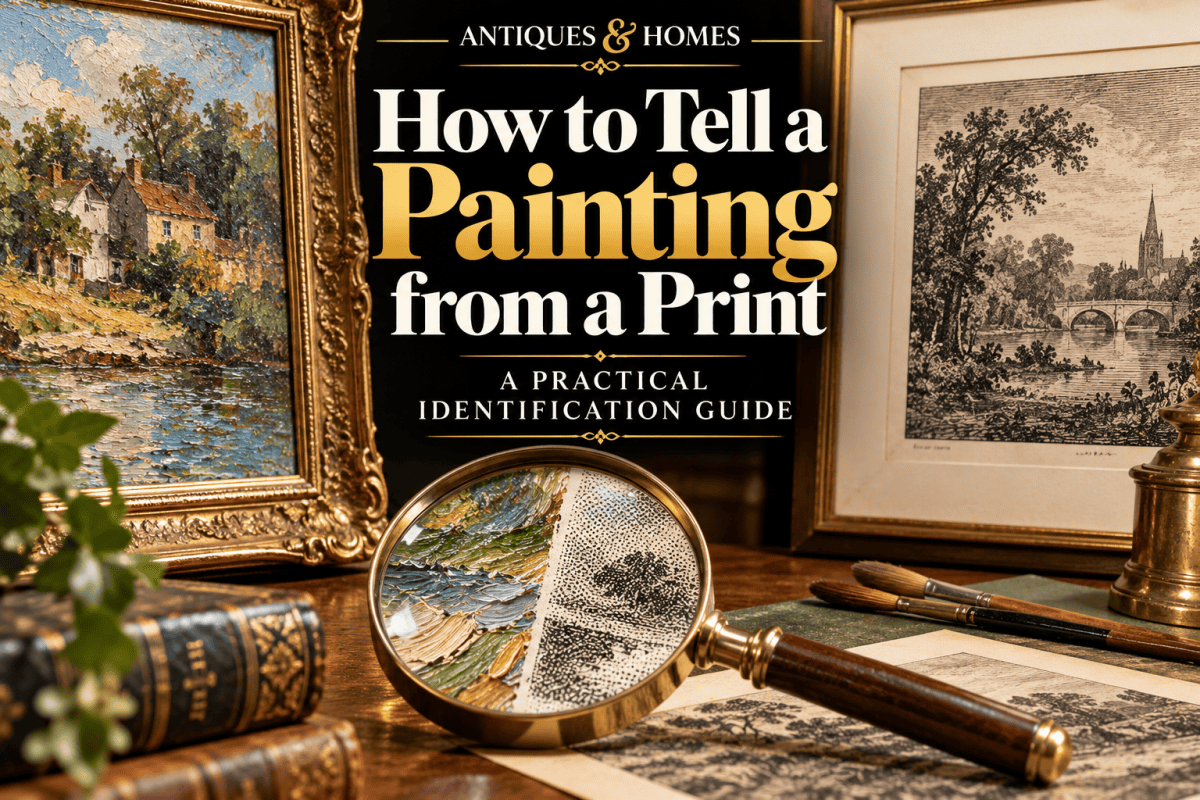
Knowing how to tell a painting from a print is one of those useful skills that can make buying antique and vintage pictures much more rewarding. Whether I’m looking at a picture in an antiques shop, browsing an auction or examining something that has spent years hanging on someone’s wall, I always find it interesting to work out exactly how the image was made.
At first glance, the distinction might seem straightforward. Paintings have brushstrokes, while prints reproduce an image on paper or canvas. However, things are rarely quite that simple. Some original paintings have remarkably smooth surfaces, while certain reproductions imitate the texture of oil paint so convincingly that they deserve a much closer look.
There’s another point worth making from the outset. Not every print is a cheap reproduction. Original etchings, lithographs, woodcuts and other fine-art prints can be important works of art in their own right. Some are highly collectible and can be worth considerably more than an ordinary original painting.
So, when I’m trying to establish whether a picture is a painting or a print, I don’t rely on one quick test. Instead, I look for several small clues that, taken together, help me understand what I’m looking at.
How to Tell a Painting from a Print: Start with the Surface
When I’m examining an old picture, I tend to look past the subject initially and concentrate on how the image was made. A lovely landscape in an ornate gilt frame can be very appealing, but it’s the surface of the picture that often provides the first useful clues.
Look for Genuine Brushstrokes
Oil and acrylic paintings frequently reveal the physical movement of the artist’s brush or palette knife. Paint may gather along the edge of a stroke, overlap neighbouring colours or form small ridges where the artist has worked repeatedly over an area.
I particularly like to examine highlights, textured backgrounds and places where contrasting colours meet. These are often the areas where individual brushstrokes become easier to recognise.
On an original painting, the texture will often relate naturally to the subject. For example, a thick highlight might follow the curve of a flower, the edge of a building or the direction of water in a landscape.
However, I wouldn’t dismiss a picture simply because the surface appears smooth. Some artists paint in exceptionally thin layers, producing almost no obvious texture. Watercolours, gouache and many paintings on board can also appear completely flat.
So, while raised brushwork can be a helpful sign, its absence certainly doesn’t prove that a picture is a print.
Use Light from the Side
One simple technique I find useful is looking across the surface of a picture rather than directly at it. When light falls at a shallow angle, small ridges and variations in the paint become much easier to see.
Conservators call this raking light, and it’s a straightforward way of revealing details that ordinary lighting can hide.
By changing my viewing position or using a suitable light source from one side, I can sometimes pick out raised brushstrokes, uneven paint layers and areas where the artist has built up the surface.
On a genuine painting, these irregularities often produce little shadows that follow the brushwork. An ordinary flat reproduction, by comparison, may show very little physical relief.
There is a catch, though. Some reproductions have textured coatings or embossed surfaces designed to imitate oil paint. Others have been embellished by hand. Consequently, I always regard surface texture as one clue rather than conclusive proof.
“When I’m examining a picture, I don’t just look for texture. I look at whether that texture makes sense in relation to the image.
How to Tell a Painting from a Print with a Magnifying Glass
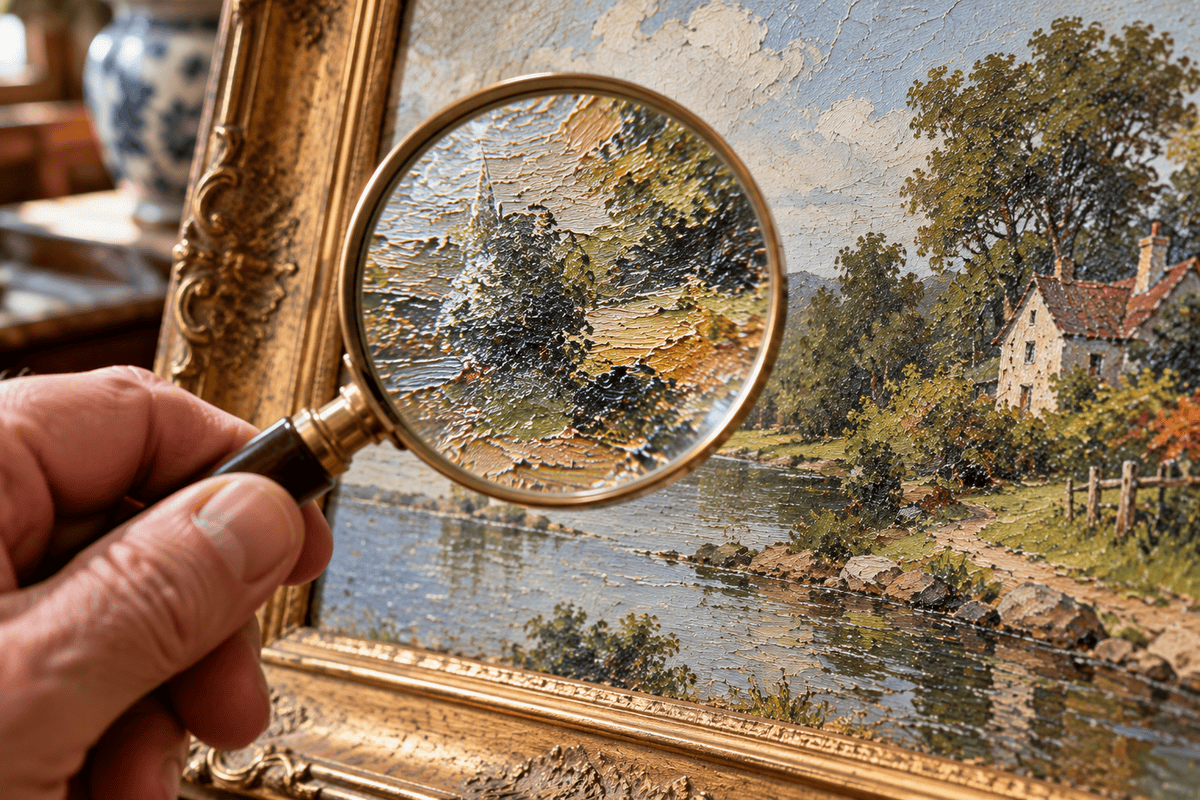
One of the first things I reach for when I’m unsure about a picture is a magnifying glass. It’s surprising how often a few seconds of closer examination can reveal something that isn’t obvious to the naked eye.
For anyone wondering how to tell a painting from a print, magnification is often one of the most revealing places to start.
A small jeweller’s loupe can be particularly useful, although an ordinary magnifying glass is often enough to make a start.
I usually choose an area containing several colours, preferably somewhere in the middle tones rather than a completely white or black section.
Look for Printing Dots and Repeating Patterns
Many commercially produced reproductions use photomechanical printing techniques. Under magnification, what looks like a smooth blend of colour may actually be made up of hundreds of tiny printed dots.
In conventional colour offset printing, these dots often form a regular arrangement known as a halftone rosette.
When I find a clear, repeating dot pattern, that’s strong evidence that I’m looking at a mechanically reproduced image rather than an original oil or acrylic painting.
However, modern digital printing can be considerably more difficult to identify. High-quality inkjet and giclée prints may have exceptionally fine ink patterns that are difficult to recognise with a basic magnifying glass.
Original etchings, lithographs and woodcuts are another matter altogether. These are genuine artistic printing processes and don’t necessarily display the familiar halftone dots found in commercial reproductions.
That’s why it’s important to understand what kind of print you’re looking at rather than assuming all printed images are the same.
Look at the Edges of Colours
Another thing I examine is where one colour meets another.
In an original painting, I might see one colour dragged into the next, a transparent glaze laid over an earlier layer or small adjustments made by the artist as the picture developed.
Printed reproductions often have more uniform characteristics. Under magnification, the way the colour has been deposited can become easier to recognise.
I prefer to check several areas rather than making a judgement from one small detail. A reproduction may have hand-painted additions, while a genuine painting can contain surprisingly neat and regular passages.
How to Tell an Oil Painting from a Print on Canvas
Canvas is something that can easily mislead people. We naturally associate it with original oil paintings, but reproductions have been printed onto canvas for many years.
When learning how to tell a painting from a print on canvas, it’s particularly important not to confuse the texture of the canvas with the texture of applied paint.
Modern printing techniques can produce some very attractive results, and a framed canvas reproduction may look remarkably like an original painting from a normal viewing distance.
When I’m examining a picture on canvas, I look at how the image relates to the weave of the material.
On an original oil painting, the paint may sit above the raised threads, settle into the hollows or completely cover the weave where the artist has applied thicker layers.
On a printed canvas, the image may follow the texture of the material more uniformly. Magnification can sometimes reveal the structure of the printing ink.
I also look at any visible edges of the image. Hand-painted brushwork may continue irregularly towards the edge, while a printed picture sometimes has a sharply defined boundary.
However, neither observation is foolproof. Artists can paint very neatly, while reproductions may be wrapped around the edges of a canvas or finished by hand.
Beware of Textured Reproductions
Some reproductions are deliberately made to look like oil paintings. A clear textured coating may be applied over the printed image, producing ridges that resemble brushstrokes.
Other examples have small amounts of genuine paint added over selected areas, often to emphasise highlights or give the picture a more convincing surface.
These can be quite deceptive, particularly when presented in a substantial gilt frame.
What I look for is texture that appears too regular, crosses areas without following the depicted brushwork or seems to sit above an otherwise printed image.
Then I examine the underlying colours with magnification.
A hand-embellished reproduction can still be an attractive decorative picture, but it’s important to recognise that it isn’t the same thing as an entirely hand-painted original.
How to Tell a Watercolour Painting from a Print
Works on paper need a slightly different approach because many genuine originals have little or no raised surface texture.
Understanding how to tell a painting from a print becomes more challenging with watercolours because both originals and reproductions can appear almost completely flat.
With watercolours, I look for the way pigment has interacted with the paper. Depending on the artist’s technique, there may be soft transitions between washes, granulation within the colour or variations in transparency.
Sometimes the artist has allowed the paper itself to provide the highlights, leaving small areas untouched.
Gouache is generally more opaque, while drawings may reveal individual pencil, charcoal, ink or pastel marks.
These details are useful, but I wouldn’t regard any of them as absolute proof. High-quality reproductions can capture the appearance of watercolour washes and paper texture remarkably well.
Once again, magnification becomes particularly helpful. I look for evidence of individual hand-applied marks, the relationship between pigment and paper fibres, and any regular printing structures.
One thing I would never recommend is wetting the paper, rubbing a mark or trying to lift a corner to see what happens. Even a small experiment can permanently damage an original artwork.
Can a Signature Help Tell a Painting from a Print?
Whenever someone shows me an old picture, the signature is often the first thing they want to discuss. That’s understandable, but I always try to establish how the picture was made before getting too excited about a name in the corner.
A signature can provide useful evidence, but knowing how to tell a painting from a print involves much more than finding an artist’s name.
An original painting may have a genuine hand-painted signature. However, a reproduction can include a printed copy of the artist’s signature taken directly from the original work.
I examine the signature closely to see whether it appears to have been applied separately or shares the same printed characteristics as the surrounding image.
A pencil signature beneath a picture can be interesting, particularly when accompanied by an edition number. It may indicate a signed fine-art print, although signatures can be added later and not every genuine print is signed.
Equally, plenty of original paintings are unsigned.
So, for me, a signature is another piece of evidence rather than a guarantee of authenticity or value.
What Does a Number Such as 24/150 Mean?
Numbers written beneath a print commonly refer to an edition. For example, 24/150 usually identifies the twenty-fourth numbered impression in an edition of 150.
You may also come across markings such as AP, which generally stands for artist’s proof.
These details can be useful when researching a picture, but they don’t automatically establish rarity, authenticity or value.
Some signed and numbered editions are original fine-art prints. Others are reproductions issued in limited quantities.
For more information, Tate’s explanation of print editions provides a useful introduction.
Original Fine-Art Prints Are Not the Same as Reproductions
This is a distinction I think every collector should understand.
When someone describes a picture as a print, they might mean a mass-produced reproduction of a famous painting. However, they could equally be referring to an original etching, engraving, lithograph or woodcut created through an artistic printmaking process.
Those are very different things.
Original fine-art prints are artworks in their own right. Depending on the artist, technique and edition, they can be highly desirable and collectible.
Etchings and Engravings
Traditional etchings and engravings are produced using a metal plate. The image is formed by recessed lines, which hold ink before it is transferred to paper under pressure.
One detail I often look for is a plate mark: a shallow rectangular indentation left by the edge of the printing plate.
A plate mark can be a useful clue, but I wouldn’t rely on it alone. Some genuine impressions have been trimmed, removing the mark, while reproductions can imitate its appearance.
The character of the lines, the paper, the ink and comparisons with documented examples are all important.
Original Lithographs
Lithography is based on the principle that grease and water repel one another. Traditionally, an artist creates an image on a prepared stone, which is then used to produce impressions.
Original lithographs can have wonderfully subtle tonal variations and marks that resemble drawing.
However, it’s worth remembering that the word lithograph is also associated with commercial printing. An original artist’s lithograph is not the same thing as an offset-lithographic reproduction of an existing picture.
Woodcuts, Linocuts and Screenprints
Woodcuts and linocuts are relief-printing techniques in which ink transfers from the raised parts of a prepared block. Screenprints use a stencil and mesh to apply ink in selected areas.
Each technique has its own characteristics, and some original prints can be recognised by their distinctive lines, areas of colour or ink application.
“I never dismiss a picture simply because it’s a print. The important thing is to understand what kind of print it is.
For anyone interested in exploring the subject further, I would recommend looking at Prints and Printmaking: An Introduction to the History and Techniques by Antony Griffiths. This illustrated reference explains traditional printmaking processes, including woodcuts, engravings and mezzotints, and places them in their historical context. Understanding how these techniques work can make examining and identifying old prints considerably more rewarding.
How to Tell a Painting from a Print by Examining the Back
When it’s possible to do so safely, I always like to look at the back of an old picture. Sometimes the reverse tells you almost as much as the front.
Old gallery labels, exhibition details, inscriptions, framers’ marks and previous owners’ names can all provide useful starting points for research.
An oil painting may be stretched over a wooden frame or painted on board, while a watercolour or print may be mounted behind glass. However, these arrangements aren’t exclusive to any particular medium.
Old labels can be especially interesting because they may connect a picture with a gallery, exhibition, retailer or previous owner.
That said, I never assume that an old frame means the artwork inside is equally old. Frames are frequently reused, pictures are reframed, and genuine artworks sometimes end up in relatively modern frames.
Likewise, an aged canvas or darkened backing board doesn’t automatically prove that a picture is original.
If the picture is securely framed, I would leave it that way. Removing old nails, backing boards or mounts simply to investigate can damage the artwork and destroy useful historical evidence.
Six Clues I Check When Identifying a Painting or Print
These six checks form the basis of how to tell a painting from a print when examining an unfamiliar picture.
Surface Texture
I look for irregular brushwork, layered paint and raised details that follow the image naturally.
Magnification
I examine the colours for regular halftone dots or other evidence of mechanical reproduction.
Paper or Canvas
I consider how the image sits on its support rather than assuming canvas automatically means painting.
Signature
I check whether the signature appears separately applied or printed as part of the image.
Edition Marks
I look for numbering, proof markings and other evidence of a printmaking edition.
Reverse & Provenance
I examine visible labels, inscriptions, construction and any documented history.
When I’m examining an unfamiliar picture, I like to work through a few straightforward observations. None provides a guaranteed answer on its own, but together they can be very revealing.
I rarely make a judgement based on one clue alone. I prefer to build up a picture of the evidence. When several details point in the same direction, I can feel much more confident about what I’m looking at.
Painting or Print? Common Identification Mistakes
Assuming an Elaborate Frame Means an Original Painting
I’ve seen plenty of ordinary prints presented in beautiful old gilt frames. Sometimes the frame is actually more interesting than the picture itself, so I always try to judge the two separately.
Antique frames were frequently reused, and reproductions have long been sold in substantial, decorative frames.
Both the picture and the frame may have interest or value, but one doesn’t authenticate the other.
Assuming Every Old Picture Is a Painting
Printed reproductions have existed for generations, and some have survived in remarkably good condition.
A picture that has hung in the same family home for a hundred years may still be a commercial print.
Age can add historical interest, but it doesn’t establish how an image was produced.
Assuming Every Signed Print Is Valuable
A signature and edition number can make a print worth investigating, but I wouldn’t regard them as proof of value.
The artist, printing technique, authenticity, edition history, condition, provenance and current collector demand all matter.
A pencil signature is something to research, not a guarantee of a valuable artwork.
Assuming Every Print Is Worth Very Little
This is probably one of the more important misconceptions to avoid.
Some original prints are sought-after artworks, while an original oil painting by an unknown amateur artist may have relatively modest commercial value.
Originality and market value are two different questions. They can influence one another, but they shouldn’t be confused.
How to Tell a Painting from a Print in Photographs
Trying to establish how to tell a painting from a print using photographs alone can be frustrating, particularly when the surface details aren’t clearly visible.
Photographs can certainly help, and I’ve found that good close-up images often reveal details that are easily missed in an ordinary overall photograph.
However, I would be cautious about making a definite identification from photographs alone.
Reflections, lighting and image processing can conceal brushwork or exaggerate surface texture. A printed image may look convincing in a photograph, while a genuine painting can appear surprisingly flat.
If I’m considering a picture online, I want to see close-ups of the surface, signature, edges and reverse wherever possible.
A short video showing light moving across the surface can also be helpful, particularly when trying to assess raised brushwork.
Even then, photographs are only preliminary evidence. More valuable or uncertain artworks may need to be examined in person by an experienced specialist.
How to Tell a Painting from a Print Without Damaging It
One thing I always encourage is careful observation rather than physical testing.
There is usually plenty to learn from looking closely, using suitable side lighting and examining details through a magnifying glass without touching the artwork itself.
I would never recommend scraping paint, rubbing a surface, applying water or cleaning products, or removing a picture from its frame simply to establish whether it’s original.
Paint, varnish, paper and historic mounts can be surprisingly vulnerable. Even apparently harmless handling can cause permanent damage.
The Museums Galleries Scotland guidance on caring for paintings and frames offers useful advice on safe handling and conservation.
If I thought a picture might be particularly important, or noticed loose paint, fragile paper or deteriorating framing, I would seek specialist advice before attempting any further examination.
Does an Original Painting Always Have Greater Value Than a Print?
Not necessarily, and this is something worth remembering when buying pictures for a collection or simply to enjoy at home.
An original painting may sound more desirable, but the art market is much more varied than that.
A modest amateur oil painting might be worth less than a well-documented original print by an established artist. Equally, an attractive old reproduction may have decorative appeal even when it has relatively little significance as a fine-art object.
When I’m considering value, I look beyond the simple painting-versus-print distinction. The artist, subject, period, technique, condition, provenance and current collector demand all contribute to the bigger picture.
It’s much the same approach I take with other antiques and collectables. Our guides to identifying genuine Murano glass and recognising vintage Empoli glass explore a similar principle: attractive appearance and familiar descriptions are no substitute for supporting evidence.
Frequently Asked Questions About Paintings and Prints
How can I tell if a picture is a real oil painting?
I would start by looking for genuine paint layers, irregular brushwork and surface texture that follows the image. Angled light and magnification can help reveal these details. However, some original oil paintings are very smooth, while reproductions may have added texture.
Can a print have brushstrokes?
Yes. Some reproductions have embossed surfaces, textured coatings or hand-painted embellishments designed to imitate oil paint. Raised texture alone doesn’t prove that the whole picture was painted by hand.
Do all prints have visible dots?
No. Conventional photomechanical reproductions may reveal halftone dots under magnification, but modern digital prints can have much finer structures. Original etchings, lithographs and other fine-art prints also have different characteristics.
Is a signed and numbered print an original?
It may be an original fine-art print, but the signature and edition number aren’t proof on their own. Limited-edition reproductions can also be signed and numbered. I would research the artist, printing technique, publisher and edition history.
What does AP mean on a print?
AP usually stands for artist’s proof. It generally identifies an impression associated with the artist rather than the ordinary numbered edition, although practices vary. An AP marking doesn’t automatically make a print more valuable.
How can I tell a watercolour from a print?
I look at how the colour interacts with the paper, including pigment granulation, variations in washes and individual brush marks. Magnification may reveal printing patterns in a reproduction, although high-quality copies can be difficult to distinguish.
Does a plate mark mean a print is genuine?
A plate mark can support the identification of an etching or engraving, but it isn’t conclusive. Some genuine impressions have trimmed margins, while reproductions can imitate plate marks. I would always look for supporting evidence.
Can an old print be valuable?
Absolutely. Original fine-art prints, historically important impressions and certain collectible reproductions can all have value. The artist, technique, condition, rarity, provenance and collector demand matter more than age alone.
Should I remove an old picture from its frame to identify it?
Generally, no. I would begin with observations that don’t disturb the framing. Historic mounts and backing materials can be fragile, and removal may damage the artwork or destroy useful evidence. If further examination is necessary, a qualified conservator or specialist is the safer option.
Conclusion: Look for Evidence, Not Just Appearance
For me, learning how to tell a painting from a print isn’t about finding one clever trick that provides an instant answer. It’s about developing an eye for the small details that reveal how a picture was made.
Surface texture, magnification, printing characteristics, signatures, materials and the history of a picture can all help. More importantly, I like to see several of those clues supporting the same conclusion before making a judgement.
I’ve always felt that understanding an object adds to the pleasure of owning it. Whether it’s a modest vintage landscape, an original etching or a painting that has been in the family for generations, discovering how it was made can be every bit as interesting as the subject itself.
And that’s part of what makes collecting antiques and vintage pictures so enjoyable. Sometimes the most interesting discovery isn’t what a picture depicts, but the story behind the picture itself.
Antiques & Homes — Old Things. Interesting Things. Beautiful Things.
Affiliate Disclosure: This article contains affiliate links. As an Amazon Associate, Antiques & Homes earns from qualifying purchases at no additional cost to you.
