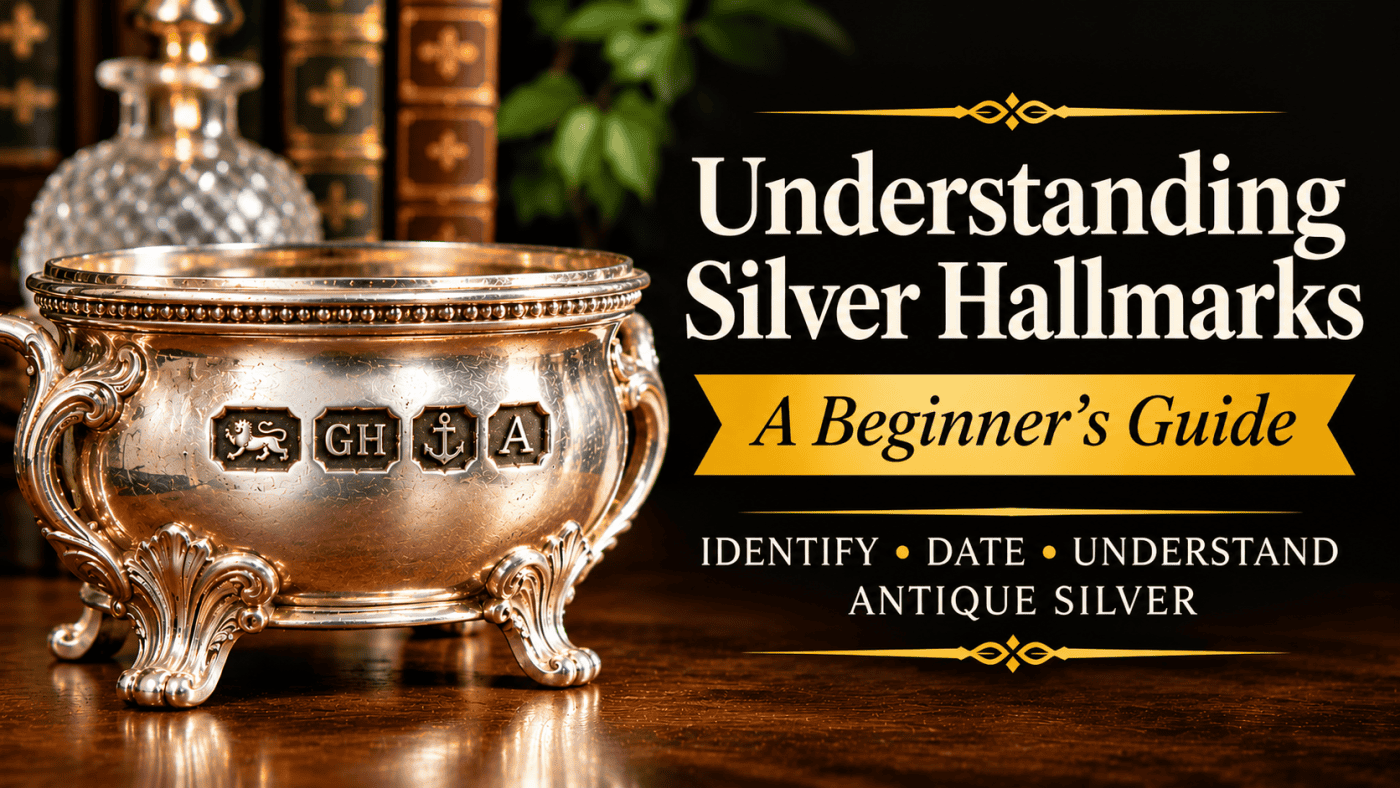
Understanding hallmarks can turn an ordinary-looking piece of silver into something much more interesting. Those tiny symbols on the back of an old spoon, underneath a silver box or inside a piece of jewellery can reveal where it was tested, how much silver it contains and, quite often, when it was hallmarked.
However, if you’ve never examined silver hallmarks before, the different letters, animals, numbers and symbols can seem rather confusing. Some marks have changed over the centuries, while others look remarkably similar to stamps found on silver-plated objects.
Fortunately, you don’t need to become an expert to understand the basics. I find it easiest to examine the marks one at a time, then put the information together. In this guide, I’ll explain what to look for, how to recognise the main British silver hallmarks and where to find reliable help when you want to investigate an older piece.
Understanding Hallmarks: What Are Silver Hallmarks?
A hallmark is an official mark applied after an independent assay office has tested the precious-metal content of an item. British hallmarking has a history stretching back centuries, and its purpose is to protect buyers by confirming that an object meets a recognised metal standard.
Silver is usually mixed with other metals to make it stronger. Therefore, simply looking at an object cannot tell us exactly how much silver it contains. Hallmarks provide a more reliable indication of its purity.
On older British silver, you’ll often find several small marks stamped together. These can identify the silver standard, assay office, date and the person or business responsible for submitting the item.
Modern UK hallmarks normally contain three compulsory elements: a sponsor’s mark, a fineness mark and an assay office mark. Date letters and traditional silver symbols are now optional.
You can read the official requirements in the UK government’s hallmarking guidance.
Understanding Hallmarks: What Do the Different Marks Mean?
When I examine an unfamiliar piece of silver, I start by looking for the main identifying symbols. Although older objects often have four or five marks, not every piece will carry exactly the same combination.
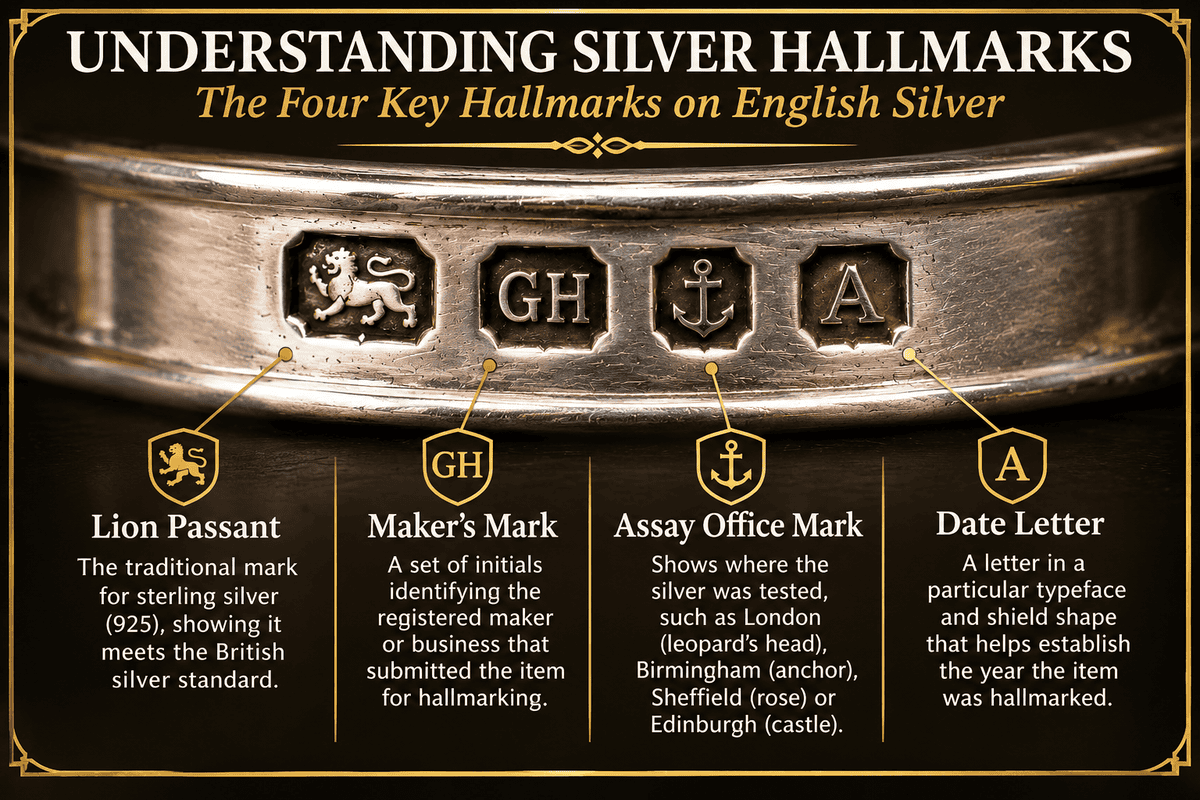
The Lion Passant – Sterling Silver
One of the most recognisable marks on English silver is the lion passant, usually shown walking with one front paw raised.
This traditional symbol indicates sterling silver, which contains at least 92.5% silver. It’s particularly useful when examining Georgian, Victorian and Edwardian silverware.
However, the lion’s appearance has varied over time, so it’s worth comparing the actual punch with a reliable hallmark reference.
The Assay Office Mark – Where the Silver Was Tested
The assay office mark tells us where an item was officially tested and hallmarked. It doesn’t necessarily tell us where the object was manufactured.
Britain currently has four assay offices, each with a distinctive symbol.
London
The traditional assay office mark associated with London.
Birmingham
Birmingham has used the anchor as its assay office mark since 1773.
Sheffield
The rose is the modern Sheffield mark. Older pieces may feature a crown.
Edinburgh
The castle is the traditional assay office symbol for Edinburgh.
For example, the anchor has been Birmingham’s official assay office mark since 1773. If I find an anchor among a recognised set of British silver hallmarks, I know the item was assayed in Birmingham. I can then use Birmingham’s historical date-letter charts to investigate its age.
Older pieces may also carry marks from former assay offices, including Chester, Exeter, Newcastle, York and Glasgow.
For a useful introduction to these symbols, visit the Goldsmiths’ Company Assay Office hallmark guide.
The Date Letter – When the Silver Was Hallmarked
Date letters are particularly useful when researching antique silver. They can help identify the year, or historical hallmarking period, in which an object was tested.
However, the same letter has been used many times throughout history. Therefore, a letter A or B cannot tell you the age of a piece on its own.
To identify the correct year, you need to look at the assay office, the style of the letter and the shape surrounding it. These details distinguish one date-letter cycle from another.
For example, a Victorian Birmingham date letter must be compared with the Birmingham chart for the relevant period. A London chart might give a completely different answer.
One important point: the date letter records hallmarking rather than necessarily the exact year an object was manufactured.
The Maker’s or Sponsor’s Mark – Who Registered the Item?
You’ll often see a pair of initials stamped alongside the other marks. Collectors commonly call this the maker’s mark, although sponsor’s mark is the more accurate term.
The initials identify the person or business registered to submit the item for hallmarking. This might have been the manufacturer, a retailer or another business.
Consequently, the sponsor wasn’t always the person who physically made the object. Nevertheless, identifying the mark can provide a useful starting point for researching its history.
The Fineness Mark – How Much Silver Does It Contain?
Modern British silver hallmarks commonly include a number indicating the minimum silver content.
The most familiar is 925, meaning sterling silver contains at least 925 parts silver per 1,000.
You may also encounter 958, which identifies the higher Britannia silver standard.
Remember that a number stamped on its own isn’t necessarily a complete British hallmark. Always examine the other marks and consider the object’s origin.
A single mark can offer a clue, but it’s the combination of hallmarks that helps reveal the story behind a piece of silver.
Understanding Hallmarks: How to Date Antique Silver
Dating antique silver is often the part that interests collectors most. After all, discovering that an ordinary-looking spoon was hallmarked during the reign of Queen Victoria can make it much more intriguing.
However, British date letters aren’t as simple as matching a letter to a year. Different assay offices historically used different lettering cycles, and the alphabet was repeated over time.
When I’m trying to date a piece, I follow three straightforward steps.
- Identify the assay office. Look for the leopard’s head, anchor, crown, castle or another recognised town mark.
- Examine the date letter. Note whether it’s a capital or lower-case letter and look carefully at its shape and surrounding outline.
- Compare it with the correct historical chart. Use a reference covering the relevant assay office and period.
It’s worth remembering that date letters became optional in 1999. Therefore, some perfectly genuine modern silver carries no date letter at all.
For older silver, a proper illustrated hallmark reference is far more useful than a basic alphabet table because it shows the actual letter styles and punch shapes.
Recommended Reference Book
Jackson’s Hallmarks – Pocket Edition
English, Scottish & Irish Silver and Gold Marks from 1300 to the Present Day
When identifying antique silver, having a reliable hallmark reference is extremely useful. Jackson’s Hallmarks is a specialist guide covering centuries of English, Scottish and Irish silver and gold marks.
Its pocket format makes it a practical companion for collectors, antique enthusiasts and anyone who enjoys researching the history of an interesting find.
VIEW JACKSON’S HALLMARKS ON AMAZONUnderstanding Hallmarks: Sterling Silver, Britannia Silver and Silver Plate
One of the most useful things a hallmark can tell us is whether an object meets a recognised silver standard. However, it’s also important to understand the difference between solid silver and silver plate.
What Is Sterling Silver?
Sterling silver contains at least 92.5% silver, with other metals added to improve strength and durability.
On older English silver, the traditional lion passant is an important indication of sterling silver. Modern pieces may instead feature the numerical fineness mark 925 as part of a complete hallmark.
What Is Britannia Silver?
Britannia silver contains at least 95.8% silver, making it a higher standard than sterling.
It was introduced in Britain in 1697, when it replaced sterling as the required standard for much wrought silver. Sterling was permitted again from 1720.
Older Britannia silver may feature a standing figure of Britannia and a lion’s head erased, while modern pieces can carry the numerical mark 958.
What Is Silver Plate?
Silver-plated objects have a layer of silver over another metal. Many antique and vintage plated pieces are beautifully made, but their markings differ from official solid-silver hallmarks.
Two common abbreviations are EPNS, meaning electroplated nickel silver, and EPBM, meaning electroplated Britannia metal.
Neither abbreviation identifies solid sterling silver.
Some plated wares also carry decorative symbols and manufacturer stamps that resemble genuine hallmarks. Therefore, it’s important to examine the complete set of marks rather than relying on a single symbol.
For more help, read our detailed guide to the difference between silver and silver plate, including the characteristics of older plated wares.
An old piece doesn’t have to be sterling silver to be interesting. Beautifully made silver plate has its own history and collector appeal.
How I Examine Hallmarks on Antique Silver
Understanding hallmarks becomes easier with practice. When I examine an unfamiliar piece, I prefer to follow a simple routine rather than trying to identify every tiny symbol at once.
These are the six checks I find most useful.
Find the Marks
I look underneath the object, around the rim, along handles and in other places where hallmarks commonly appear.
Check the Silver Standard
I check for the lion passant, Britannia symbol, 925, 958 or any indication of plating.
Identify the Assay Office
I look for a recognised town mark, such as Birmingham’s anchor or London’s leopard’s head.
Examine the Date Letter
I note the letter’s style and shape before comparing it with a suitable historical chart.
Check the Sponsor’s Mark
I look for initials that might help identify the registered business or individual.
Consider the Whole Object
I compare the hallmarks with the design, construction, condition and any known history.
Good lighting makes a considerable difference. I often find that gently changing the angle of the object reveals details that were almost invisible at first.
Clear close-up photographs can also help when comparing marks with a reference book. However, avoid heavy polishing or abrasive cleaning around the stamps, as this can remove valuable detail.
Can Genuine Silver Have No Hallmarks?
Yes. Although hallmarks are extremely useful, their absence doesn’t automatically mean an item is silver plated.
Under current UK law, silver articles weighing less than 7.78 grams are generally exempt from compulsory hallmarking, subject to the relevant conditions. There are also exemptions for certain older items.
For example, qualifying pre-1950 articles may be exempt where their age and silver content can be established.
However, I wouldn’t assume an unmarked object is sterling silver simply because it looks old. If identification matters, further research or professional testing may be necessary.
If you’re unsure whether an unfamiliar object is silver or another metal, our guide to telling silver from pewter explains several practical differences.
Does a Silver Hallmark Make an Antique Valuable?
A hallmark can tell us a great deal about an object’s identity, but it doesn’t automatically make the item valuable.
Some everyday silverware is worth little more than its silver content, while unusual pieces by desirable makers may attract much stronger collector interest.
When considering value, I look at the age, maker, design, rarity, condition and demand, as well as the silver content.
For example, a common Victorian silver spoon may be relatively modest in value, while a rare piece of Arts and Crafts silver could be considerably more desirable.
Ultimately, hallmarks provide useful evidence, but the whole object determines its appeal.
Common Mistakes When Understanding Hallmarks
It’s easy to make assumptions when examining unfamiliar silver, particularly if some of the marks are worn or difficult to read.
Assuming Every Anchor Means Solid Silver
The anchor is Birmingham’s official assay office symbol, but some plated wares also carry anchor-like decorative marks. Look for a recognised combination of genuine hallmarks before identifying an object as solid silver.
Dating an Item from One Letter
Date letters have been repeated over the centuries. The assay office, lettering style and surrounding shape all matter.
Confusing a Sponsor’s Mark with the Actual Maker
The sponsor’s initials identify the registered party responsible for submitting an item for hallmarking. That person or business wasn’t necessarily its manufacturer.
Assuming All Old Silver Must Be Hallmarked
Historical rules and exemptions differ from modern requirements. Therefore, the absence of marks doesn’t provide a complete answer on its own.
Believing a Hallmark Guarantees High Value
A hallmark helps identify an object, but collector demand, craftsmanship, condition and rarity are equally important when assessing value.
Frequently Asked Questions About Understanding Hallmarks
What does the lion mean on silver?
The lion passant is the traditional English symbol associated with sterling silver, containing at least 92.5% silver.
What does an anchor mean on silver?
The anchor is the official mark of Birmingham Assay Office, established in 1773. It identifies where an item was hallmarked rather than necessarily where it was manufactured.
How can I tell how old my silver is?
First identify the assay office, then examine the date letter and compare its style and surrounding shape with the appropriate historical chart.
What does 925 mean on silver?
925 indicates sterling silver, containing at least 92.5% silver. However, a standalone 925 stamp isn’t necessarily a complete British hallmark.
What is the difference between sterling and Britannia silver?
Sterling silver contains at least 92.5% silver, while Britannia silver contains at least 95.8%. Both are recognised British silver standards.
Why does my silver have no date letter?
British date letters became optional in 1999. Therefore, modern silver can carry a valid hallmark without one.
Is EPNS solid silver?
No. EPNS means electroplated nickel silver, which has a silver coating over a base-metal alloy.
Can Victorian silver be identified from its hallmarks?
Often, yes. The assay office, date letter and sponsor’s mark can provide useful information, although worn marks may require further research.
Does a hallmark mean my silver is valuable?
Not necessarily. A hallmark helps establish identity and silver purity, but value also depends on the maker, age, design, rarity, condition and collector demand.
Final Thoughts on Understanding Hallmarks
Understanding hallmarks doesn’t have to be complicated. Once you recognise the lion passant, the main assay office symbols and the purpose of date letters, you’ll already have a useful foundation for identifying British silver.
My advice is to examine the marks together rather than relying on one symbol. Then use a trustworthy reference to check the finer details, particularly when researching Georgian, Victorian or Edwardian silver.
Above all, enjoy the detective work. Discovering the history behind an old silver object is one of the pleasures of collecting antiques, and every hallmark has the potential to reveal another part of its story.
*Affiliate Disclosure: This article contains affiliate links. As an Amazon Associate, Antiques & Homes earns from qualifying purchases at no additional cost to you.
