
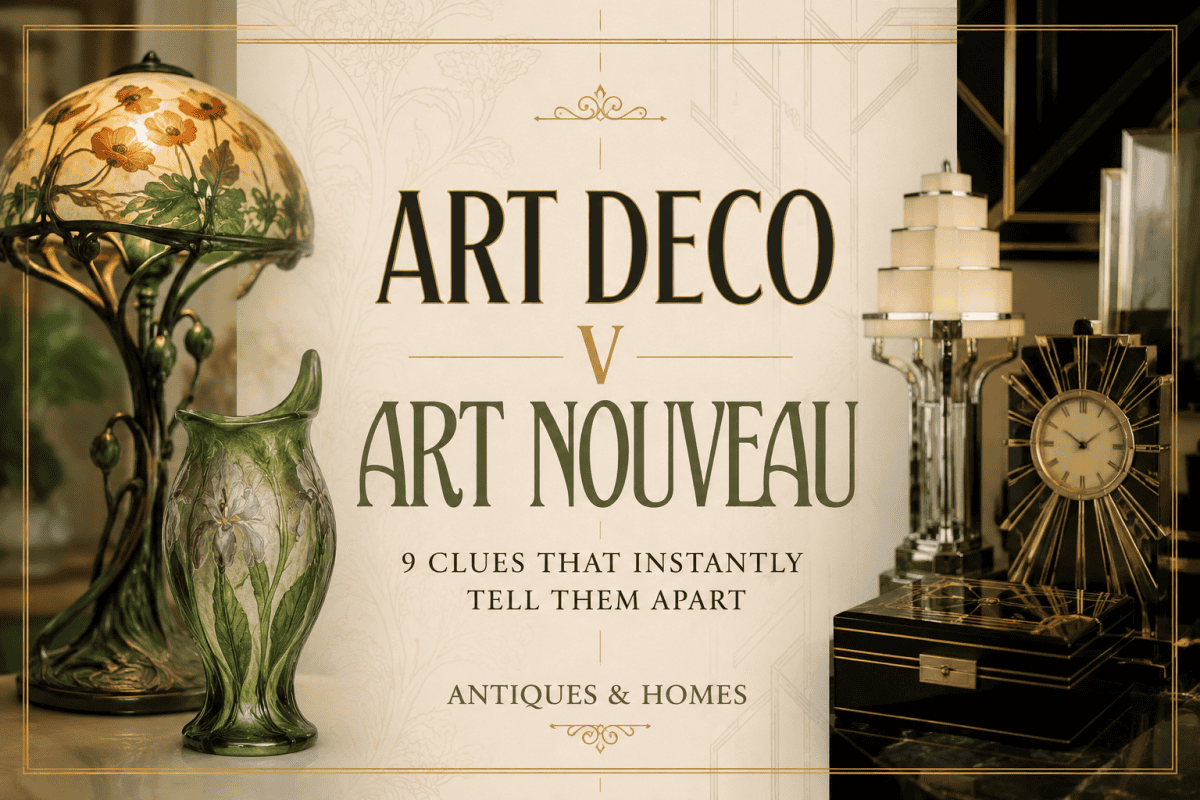
Art Deco v Art Nouveau? That is the question.
A lamp stands in the corner of an antiques centre, half hidden behind a walnut cabinet and a stack of old picture frames. Its bronze stem curls upwards like a plant searching for light, while the glass shade opens above it like a flower. The label says Art Deco. The shape says otherwise.
It is an easy mistake to make. Art Deco v Art Nouveau sounds like a comparison between two closely related styles, yet the two movements looked at the world in almost opposite ways. The movement of Art Nouveau found inspiration in stems, insects, flowers, water and the human form. Art Deco preferred geometry, speed, symmetry and the polished confidence of the modern city.
Once you learn to notice that difference in attitude, the labels become far less confusing. A vase, sideboard or mirror begins to reveal its period through the way its lines move, the materials it celebrates and the world its designer imagined.
This is not simply a question of dates. Instead, it is about learning to look at an object as a collector would: standing back first, following the outline and allowing the design to speak before searching for a maker’s mark.
Quick Answer: Art Deco v Art Nouveau
Art Nouveau usually features flowing, organic lines inspired by flowers, plants, insects and the human body. It flourished around the turn of the twentieth century and often appears romantic, natural and slightly dreamlike.
Art Deco became closely associated with the 1920s and 1930s. It favours symmetry, stepped outlines, sunbursts, zigzags and polished modern materials. In simple terms, Art Nouveau seems to grow, while Art Deco appears to have been designed with a ruler.
Two Styles, Two Different Worlds
To understand Art Deco v Art Nouveau, it helps to imagine the worlds that created them.
Art Nouveau emerged during the closing years of the nineteenth century, when many designers had grown tired of endlessly copying Gothic, Classical and Renaissance decoration. They wanted something new, yet they did not look towards machines for inspiration. They looked outside the window.
Leaves, seed heads, orchids, dragonflies and flowing hair began to creep across furniture, posters, jewellery and glass. Architecture itself appeared to bend and grow. In the finest examples, decoration did not merely sit on the surface; it became part of the object’s structure.
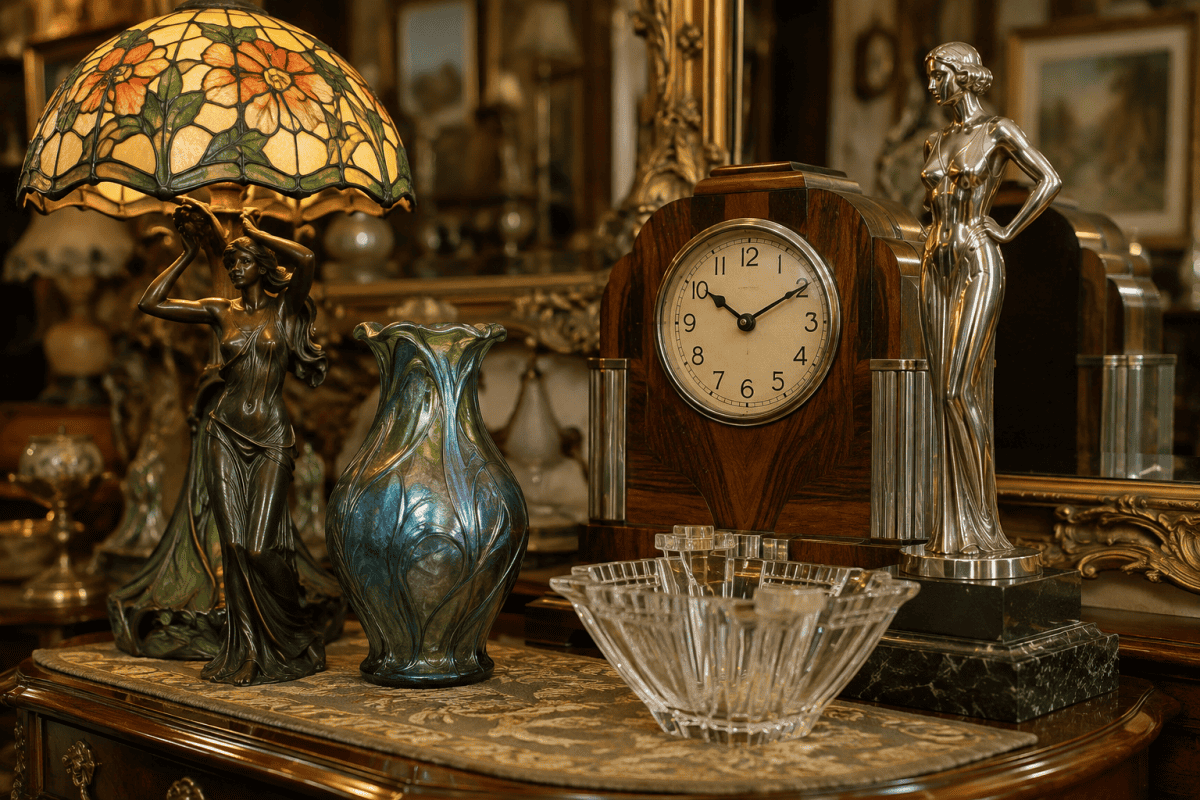
Art Deco belonged to a different mood. The world had changed, cities had grown taller and transport had become faster. Ocean liners, cinemas, motorcars and electric lighting offered a new visual language. Designers responded with strong outlines, polished surfaces and a sense of order that suited the confidence of the machine age.
However, the change was not immediate. Some early Art Deco pieces retained stylised flowers and natural motifs, while certain Art Nouveau designers already experimented with geometry. Consequently, collectors occasionally find pieces that seem to stand with one foot in each movement.
“Art Nouveau looked towards nature. Art Deco looked towards the future.”
Antiques & Homes Collector’s Advice
Stand Back Before You Look Closely
When an unfamiliar object catches your eye, the temptation is to move closer immediately. You search for a signature, inspect the base and begin looking for clues in the decoration. Yet the quickest answer often appears from several feet away.
Art Nouveau tends to create movement. A cabinet leg may seem to stretch downwards like a stem, while a lamp support twists upwards as though it has grown naturally from the base. Curves rarely feel perfectly controlled. Instead, they change direction, overlap and continue into neighbouring parts of the object.
Art Deco usually makes a stronger first impression. Its silhouettes feel deliberate and balanced. A mirror may rise in steps, a clock may form a fan, while a sideboard can appear almost architectural. Even when curves are present, they often repeat symmetrically or sweep smoothly across a streamlined surface.
This is where many misidentifications begin. A curved object is not automatically Art Nouveau, just as a geometric object is not always Art Deco. The important question is not simply whether the line bends, but how it behaves.
Three Questions To Ask Before Reading The Label
Does It Seem To Grow?
Long stems, curling outlines and shapes that appear to unfold naturally often suggest Art Nouveau.
Does It Feel Ordered?
Strong symmetry, repeated angles and stepped forms more commonly belong to Art Deco.
What World Inspired It?
Nature, flowers and insects point one way. Skyscrapers, travel and machinery point another.
The Curve That Gives Art Nouveau Away
Art Nouveau has one particularly memorable line. It sweeps forward, bends sharply and then continues in another direction, almost like a plant caught by a gust of wind. Designers used it across posters, jewellery, stained glass, furniture and metalwork.
Collectors often call this the whiplash curve, although the phrase can make it sound more violent than it appears. In practice, the line has grace and tension. It creates the impression that the object might continue growing if left undisturbed.
You may find it in the hair of a female figure, the stem of a bronze lamp or the outline of a carved chair back. On silver and jewellery, it can form wings, petals or curling tendrils. Because the line often shapes the entire object, structure and decoration become difficult to separate.
Variation
However, not every Art Nouveau piece resembles a tangled vine. British and Scottish designers sometimes used more restrained geometry. Charles Rennie Mackintosh, for example, combined tall straight lines with stylised roses and delicate organic details. His work reminds collectors that movements contain regional voices rather than one fixed appearance.
Therefore, the safest approach is to judge the complete mood. Does the design feel alive, irregular and rooted in nature? If so, the object probably belongs to the Art Nouveau tradition, even when its outline appears surprisingly formal.
Art Deco Arrives With Confidence
Art Deco does not usually creep across an object. It announces itself.
A sunburst mirror spreads across the wall. A cocktail cabinet rises in neat steps. A chrome lamp balances a frosted globe with almost mathematical precision. The decoration may be luxurious, but the design remains controlled.
Zigzags, fans, chevrons and concentric circles became part of the visual language. Ancient Egyptian and Central American forms also found their way into interiors, jewellery and ceramics, although designers simplified them into strong patterns suitable for modern rooms.
The influence of architecture is particularly noticeable. Tall stepped forms echo skyscrapers, while horizontal bands suggest speed and movement. During the 1930s, the sharper geometry often softened into streamlined curves inspired by aircraft, ocean liners and motorcars.
Those later curves can confuse the eye. Nevertheless, they are usually smooth, polished and repeated rather than wild or botanical. An Art Deco curve feels engineered. An Art Nouveau curve feels as though it has grown.
Collector’s tip: Dates can support an identification, but they should never replace looking. Traditional designs continued through the 1920s and 1930s, while later revivals copied both movements.
A Sideboard Can Reveal An Entire Era
Few objects show the contrast between the two movements as clearly as furniture. A sideboard, cabinet or chair offers enough space for outline, material and decoration to work together, almost like a small piece of architecture.
Art Nouveau
An Art Nouveau cabinet may seem to have grown from the floor. Its legs can stretch like roots, while carved leaves travel around door panels and curl into the handles. Even the join between two pieces of wood may become part of the flowing design.
Art Deco
By contrast, an Art Deco sideboard often appears confident and self-contained. Doors sit within a balanced frontage, veneers form deliberate patterns and corners may step outwards or curve neatly around the body. Handles often resemble bars, fans or simple geometric blocks.
The finest French examples can feel lavish, using lacquer, marble and rare veneers. British furniture made for ordinary homes was generally quieter. Walnut veneer, rounded corners and Bakelite handles still created an unmistakably modern appearance without the expense of exotic materials.
However, collectors should remain cautious. Bow-fronted cabinets, dark polished wood and curved legs appear across many periods. The question is whether the whole design speaks the language of Art Deco or Art Nouveau, rather than whether one isolated feature appears to fit.
The Lamp That Gives Everything Away
If one object captures the personality of an entire design movement, it is probably the table lamp. Few antiques reveal their character quite so quickly.
An Art Nouveau lamp often appears to bloom. Bronze stems curl upwards, stained-glass shades open like flowers and dragonflies settle among leaves. The base, support and shade feel connected, as though the whole piece has grown together.
An Art Deco lamp has a different ambition. It may resemble a miniature building, with a stepped base, a clean metal column and a frosted-glass shade shaped like a fan or globe. Female figures sometimes appear, although their poses are usually sleek, theatrical and stylised rather than dreamlike.
Later reproductions have complicated the picture. Tiffany-style shades, Deco dancers and frosted-glass lamps remain popular, so style alone cannot prove age. Construction, fittings, wiring and maker’s marks must support the visual evidence.
“Art Nouveau turns a lamp into a flower. Art Deco turns it into architecture.”
Antiques & Homes Collector’s Advice
Art Deco v Art Nouveau? – Materials Tell Their Own Story
Wood, glass, bronze and ceramics appear in both movements, so no material identifies a style by itself. The difference lies in the way designers used it.
Art Nouveau makers often encouraged materials to imitate the natural world. Layered glass suggested petals or mist, carved wood resembled stems and patinated bronze created the colour of leaves, insects and earth.
Art Deco designers preferred contrast and polish. Chrome sat beside black lacquer, pale inlay cut across dark veneer and frosted glass glowed against polished metal. Early plastics, including Bakelite, allowed modern-looking objects to reach homes far beyond the wealthiest buyers.
Surface condition can alter these clues. Heavy polishing may remove an original patina, while replacement handles or later lacquer can disguise the character of furniture. As with identifying silver or pewter, the strongest conclusion comes from several details supporting one another.
Glass And Ceramics Make The Contrast Beautifully Clear
Place an Art Nouveau vase beside an Art Deco one and the difference often becomes clear before either piece has been turned over.
The Art Nouveau vase may swell gently from the base before narrowing into a neck that seems to stretch upwards like a stem. Colour drifts across the surface rather than sitting within neat boundaries. Iridescence, trailing leaves and softly modelled flowers encourage the eye to travel around the object.
The Art Deco vase is more likely to hold its ground. Its shoulders may rise sharply, its handles may form steps or angles, while its decoration often appears in deliberate bands, fans or blocks of contrasting colour. Even a rounded form can possess a strong underlying order.
Known Names
Names such as Gallé, Daum, Loetz and Tiffany remain closely associated with Art Nouveau glass, although each workshop developed its own character. Their finest pieces use colour, surface and form so successfully that the glass appears almost alive.
Art Deco glass often relies on bolder silhouettes and more controlled decoration. Frosted figures, geometric cutting and strong colour contrasts create a sharper visual rhythm. René Lalique provides a fascinating bridge between the periods because his earlier work carries Art Nouveau influences, while his later glass embraces the stylised forms and repeated patterns associated with Art Deco.
Ceramics tell a similar story. An Art Nouveau pot may carry water lilies, irises or stems that follow the curve of the body. Art Deco ceramics often use angular handles, stepped profiles and painted decoration that appears deliberately modern. Clarice Cliff’s work remains among the most recognisable British examples, but bright colour alone does not make a piece Art Deco.
Look Beyond The Decoration
Follow The Form
A flowing, swelling or plant-like silhouette often supports an Art Nouveau identification.
Notice The Rhythm
Repeated bands, stepped shoulders and strong symmetry more often suggest Art Deco.
Turn It Over
Signatures, factory marks and model numbers can support what the design has already suggested.
Jewellery Brings The Two Styles Close To The Skin
Jewellery makes the contrast between Art Deco v Art Nouveau feel particularly personal because each movement imagined the wearer differently.
Art Nouveau jewellery often seems to wrap itself around the body. A brooch may become a dragonfly, a pendant may resemble a seed head and a woman’s hair may dissolve into wings, smoke or water. Enamel, horn and coloured glass could matter as much as expensive stones because the artistic idea came first.
The finest pieces feel less like conventional jewellery and more like miniature sculpture. René Lalique and his contemporaries used unusual materials because they offered colour, translucency and texture that diamonds alone could not provide.
Art Deco jewellery presents a cleaner and more deliberate glamour. Diamonds, platinum, onyx, emeralds and sapphires form neat geometric arrangements, while long earrings and narrow bracelets complement the fashions of the 1920s and 1930s.
Costume Jewellery
Even costume jewellery adopted the mood. Coloured glass, chrome-like finishes and sharply outlined shapes allowed ordinary buyers to enjoy a little of the sophistication associated with cinemas, cocktail bars and modern city life.
When looking at jewellery, ask whether the design seems to grow around the wearer or sit upon them with crisp theatrical confidence. That small distinction often reveals more than the gemstones themselves.
Imagine Them In The Same Room
Sometimes the easiest way to understand Art Deco v Art Nouveau is to stop looking at individual objects altogether.
Instead, imagine walking into two beautifully decorated rooms.
The first feels calm, elegant and almost dreamlike. Light filters through stained glass, bronze lamps curl upwards like growing plants and polished cabinets seem to flow naturally into their surroundings. Flowers appear everywhere, although not always in obvious ways. Handles resemble stems, mirrors soften at the edges and every curve seems to lead your eye gently towards the next.
Now walk into the second room.
Immediately everything feels different. A sleek walnut sideboard catches the light beneath a dramatic sunburst mirror. Chrome glints from a table lamp while bold geometric patterns repeat across rugs, clocks and ceramics. Nothing feels accidental. Every line has purpose, every shape feels balanced and every surface reflects the confidence of a rapidly modernising world.
Neither room is more beautiful than the other. In fact, collectors spend a lifetime arguing about which they prefer. One celebrates nature, craftsmanship and flowing organic design. The other embraces progress, luxury and the excitement of the machine age.
That simple picture is often far more useful than memorising dates, motifs or furniture styles. Once you can imagine those two rooms, you will begin recognising the personality behind the objects themselves. A vase, lamp or cabinet stops being just another antique and starts telling you which world it belongs to.
“Art Nouveau invites nature indoors. Art Deco invites the modern world.”
Antiques & Homes Collector’s Advice
The Labels That Lead Collectors Astray
Walk around enough antiques fairs and you soon discover that Art Deco has become one of the most generously applied labels in the trade. Almost anything from the first half of the twentieth century can find itself described that way.
A 1930s date does not automatically make an object Art Deco. Traditional oak furniture, revival ceramics and purely functional household wares continued alongside the fashionable modern styles of the period.
Art Nouveau suffers a similar fate. A piece covered with flowers may be described as Art Nouveau even when its shape and decoration belong firmly to the Victorian revival tradition. Flowers alone are not enough. They need to participate in the flowing structure and mood of the design.
Modern reproductions create another difficulty. Tiffany-style lamps, bronze dancers, sunburst mirrors and decorative figures remain popular, so a convincing style does not guarantee period manufacture.
This does not make later pieces undesirable. A well-designed revival object can still be decorative and collectable. It simply needs to be described honestly for what it is.
Four Traps To Avoid
Trusting The Label
Seller descriptions are a useful starting point, but they should never be your only evidence. Let the object make its own case before believing the label.
Dating By Colour
Bright colours do not automatically mean Art Deco, while softer, muted colours do not automatically belong to Art Nouveau. Look beyond the surface.
Ignoring Replacement Parts
Replacement lamp shades, furniture handles, mirrors and upholstery can dramatically alter the appearance of an object and make identification much harder.
Style Doesn’t Prove Age
Many excellent revival pieces faithfully copy both movements. A convincing Art Deco or Art Nouveau design does not automatically mean it was made during the original period.
Assuming Style Proves Age
A convincing Art Deco or Art Nouveau design may have been produced many decades later.
The same careful approach applies whenever you identify antique materials or styles. As our guide to telling ivory from bone explains, one persuasive clue should encourage further inspection rather than end it.
A Thirty-Second Look Before You Buy
There is rarely time for a full history lesson when you are standing in a busy antiques centre with another buyer hovering nearby. Fortunately, a quick inspection can still reveal a great deal.
Begin with the silhouette. Then allow your eye to move across the decoration, materials and construction. By the time you search for a label or signature, you should already have a strong impression of the design language.
How Dealers Read An Object
Spend a morning watching experienced dealers at an antiques fair and you will notice something curious. Very few pick an object up immediately.
Instead, they pause.
They stand back for a few seconds and allow the overall shape to make the first impression. Only then do they begin moving closer, almost allowing the object to introduce itself.
The Collector’s Eye
Step Back First
Before looking at details, take in the silhouette. Does it seem to have grown naturally, or has it been carefully engineered into a balanced geometric form?
Let Your Eye Wander
Follow the lines through the piece. Curving stems and flowing movement often suggest Art Nouveau, while repeated angles, fans and stepped forms point towards Art Deco.
Look Beyond Decoration
Flowers and dragonflies tell one story. Sunbursts and chevrons tell another. However, always ask whether the decoration belongs naturally to the shape beneath it.
Read The Materials
Patinated bronze, carved timber and layered glass create a very different atmosphere from polished chrome, lacquer, marble and sleek veneers.
Inspect The Construction
Only now should you begin looking for replacement parts, modern screws, rewiring or repairs that may reveal a later reproduction.
Finish With The Evidence
Maker’s marks, signatures and labels should confirm what your eyes have already suspected, not persuade you to ignore everything else.
It sounds like a slow process, yet experienced collectors can often work through these observations in less than thirty seconds. The important lesson is not to begin with the label. Begin with the object itself.
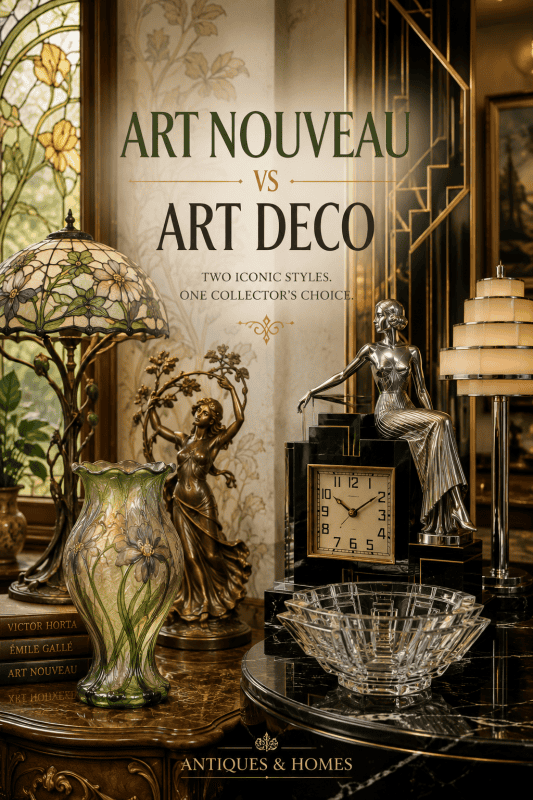
Which Style Is More Valuable?
The words Art Deco and Art Nouveau can add excitement to an auction description, but neither guarantees value.
A modest factory-produced Art Deco ornament may sell for far less than a rare Art Nouveau vase by an important maker. Equally, a documented Lalique figure can command a far higher price than an unsigned piece of decorative Art Nouveau metalwork.
Maker, rarity, quality, condition and provenance matter far more than the movement alone. Original fittings and surfaces are particularly important. Drilled vases, replacement lamp shades, altered furniture and over-polished metalwork can all reduce desirability.
Signatures
Signatures also deserve care. Popular names attract copies, later reproductions and optimistic attributions. Compare unfamiliar marks with museum examples, specialist reference books and reputable auction records before drawing conclusions.
The Victoria and Albert Museum holds important collections from both movements and provides useful background through its Art Nouveau collection and Art Deco collection.
Collector’s tip: A style describes the appearance of an object, not its maker or quality. The strongest designs remain desirable because they are well made, original and visually convincing.
Art Deco v Art Nouveau FAQs
Which came first, Art Nouveau or Art Deco?
Art Nouveau came first and flourished mainly from the 1890s until around the First World War. Art Deco became internationally fashionable during the 1920s and remained influential throughout the 1930s.
What is the quickest way to identify Art Deco v Art Nouveau?
Study the overall lines. Flowing, organic and plant-like shapes usually suggest Art Nouveau, while strong symmetry, geometry and stepped forms usually suggest Art Deco.
Can one object combine both styles?
Yes. Transitional pieces can combine natural motifs with stronger geometry, while regional designers and later revivals borrowed freely from both movements.
Is every object made in the 1930s Art Deco?
No. Traditional, revival and purely functional designs continued alongside Art Deco. The date gives context, but the design itself determines the style.
Are curved objects always Art Nouveau?
No. Streamlined Art Deco also uses curves. Art Nouveau curves tend to resemble natural growth, while Art Deco curves usually appear smoother, more symmetrical and more engineered.
Is Art Deco more valuable than Art Nouveau?
Not automatically. Maker, quality, rarity, condition and provenance determine value. Important examples from either movement can be highly valuable.
How can I recognise a modern reproduction?
Check construction, fittings, wiring, wear, labels and materials. Modern screws, artificial ageing and inconsistent replacement components may indicate a later copy.
Art Deco v Art Nouveau: The Difference You Can Feel
The clearest distinction between Art Deco v Art Nouveau is not hidden in a date book. It lies in the feeling created by the object.
Art Nouveau belongs to a world of curling stems, shifting light and forms that appear to grow naturally from the material. Art Deco belongs to a world of electric cities, ocean liners, cinema, polished surfaces and carefully controlled glamour.
The next time you encounter an unfamiliar lamp, vase, mirror or sideboard, pause before reading its label. Stand back. Follow the lines. Notice whether the decoration comes from nature or geometry, and whether the object feels romantic or deliberately modern.
Some transitional and revival pieces will continue to resist a simple answer. That is part of their interest. Nevertheless, by combining silhouette, decoration, materials, construction and marks, you can move far beyond guesswork and begin seeing the object through the eyes of its designer.
Build Your Collector’s Library
Experienced collectors often say their greatest purchases were not always antiques, but the reference books that taught them what to look for. Studying authentic examples from museums, auction catalogues and respected authors quickly develops the eye, making it easier to recognise original design, quality craftsmanship and the subtle details that separate exceptional pieces from ordinary ones.
If today’s article has sparked your interest, these carefully curated book collections provide an excellent starting point for exploring both design movements in greater depth.
Art Nouveau Books
Discover beautifully illustrated books covering Art Nouveau furniture, glass, jewellery, architecture and decorative arts. Ideal for collectors wanting to recognise the movement’s flowing organic style with greater confidence.
Browse the Art Nouveau book collection →
Art Deco Books
Explore books celebrating the glamour of the Art Deco era, from furniture and interiors to glass, ceramics, jewellery and iconic twentieth-century design.
Browse the Art Deco book collection →
Affiliate disclosure: Antiques & Homes may earn a small commission from qualifying purchases made through links on this page. This does not affect the price you pay and helps support the website.
