
Preserving antique books is one of the most important skills any collector can learn. Whether you collect old books, maps, postcards, documents, photographs, letters or paper ephemera, proper care can mean the difference between a treasured item surviving for generations or deteriorating beyond repair.
Unlike furniture, ceramics or metalware, paper is surprisingly fragile. Sunlight, moisture, poor storage and even careless handling can cause irreversible damage. Fortunately, preserving antique books does not require specialist training. In most cases, a few simple precautions will dramatically increase the lifespan of your collection.
As antique dealers, we regularly encounter books and paper items that have survived for over a century. Some remain in remarkable condition, while others show the effects of decades of neglect. The difference often comes down to how they were stored and handled.
Quick Answer: How Do You Preserve Antique Books and Paper?
Preserve antique books and paper by keeping them away from direct sunlight, damp, heat and sudden changes in humidity. Handle them with clean, dry hands, support fragile bindings and use acid-free folders, sleeves or storage boxes where appropriate. Never use sticky tape, laminate old documents or attempt major repairs without professional conservation advice.
If you enjoy collecting antiques in general, you may also find our guide on how to identify antique furniture useful when exploring other areas of collecting.
Why Preserving Antique Books Matters
Many collectors focus on acquiring interesting items but spend less time considering long-term preservation. However, once deterioration begins, reversing the damage often becomes difficult or expensive.
Paper naturally contains acids that slowly break down fibres over time. Consequently, even well-preserved books age gradually. Environmental factors can accelerate this process dramatically.
Good preservation helps maintain appearance, prevent mould, reduce fading, protect historical information and preserve long-term collector appeal.
The Biggest Enemies of Antique Paper
Understanding what causes damage makes preservation much easier. Sunlight, damp, heat and dust all threaten antique books and paper in different ways.
Sunlight
Direct sunlight remains one of the most destructive forces affecting antique books and paper. Ultraviolet light breaks down paper fibres and gradually causes inks, illustrations and bindings to fade.
Damp and Humidity
Moisture creates ideal conditions for mould growth. Fluctuating humidity also causes paper to expand and contract, slowly weakening its structure over time.
Heat
Excessive heat accelerates the ageing process. Radiators, fireplaces and hot airing cupboards should never serve as storage locations for antique books or documents.
Dust and Dirt
Dust may appear harmless, yet it attracts moisture and airborne pollutants. Over time, dirt can become embedded within paper fibres and prove difficult to remove safely.
How to Store Antique Books Correctly
Proper storage forms the foundation of preserving antique books.
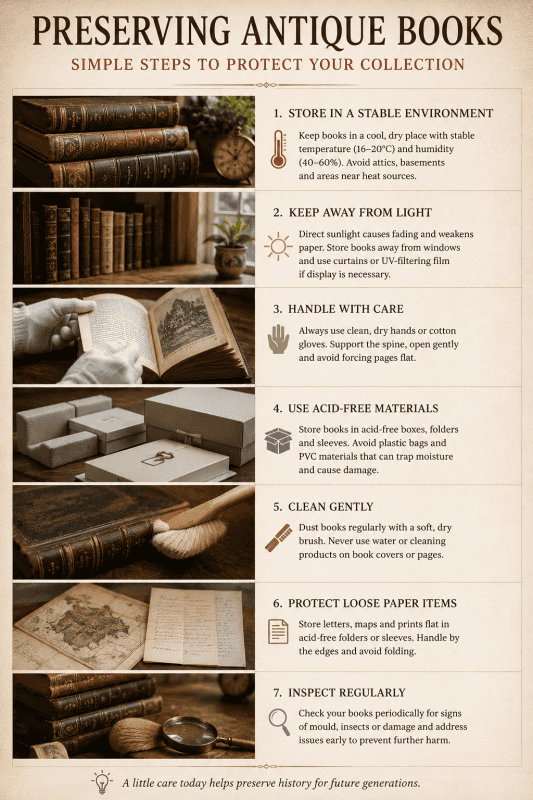
Ideally, books should stand upright on shelves, supported by neighbouring volumes of similar size. Large books may require flat storage if their weight places stress on the spine.
Collectors should avoid overcrowding shelves. Books need sufficient space for safe removal without pulling on the top of the spine.
The ideal environment includes stable room temperature, moderate humidity, good air circulation, clean shelving and protection from direct sunlight.
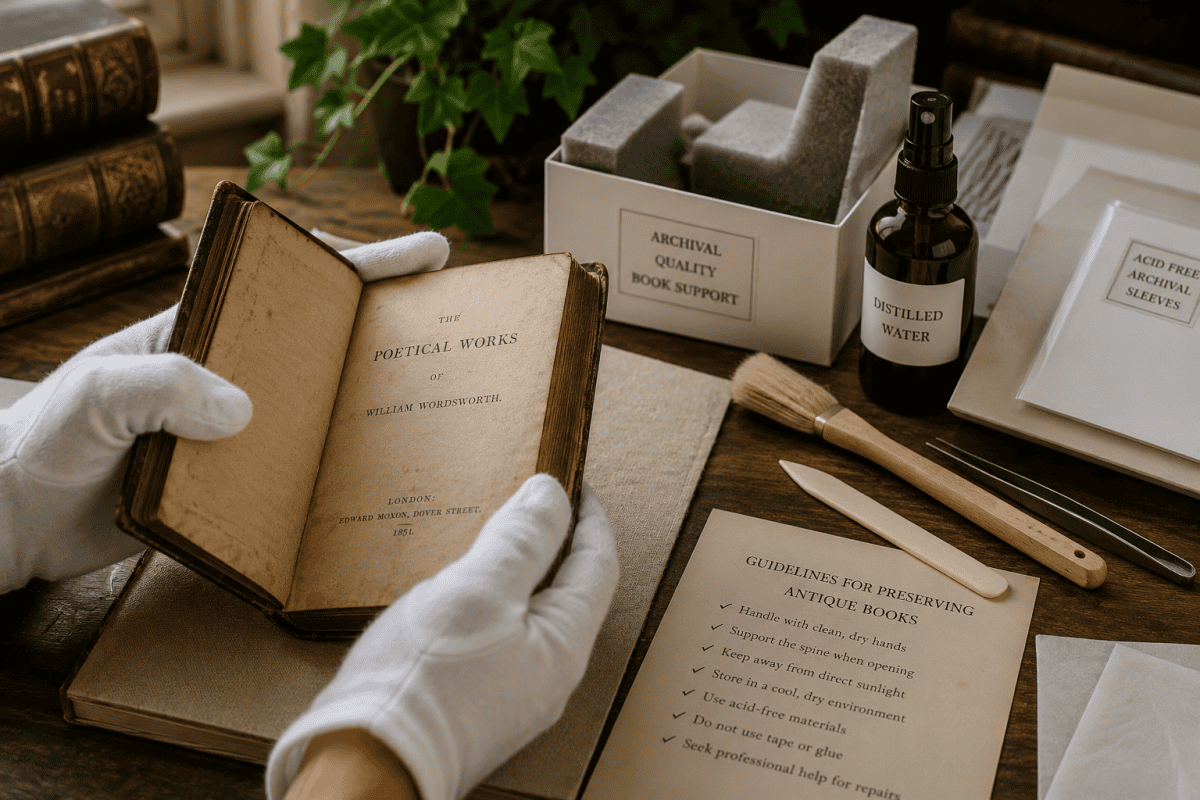
Collectors who wish to improve storage conditions may also wish to consider using acid-free archival storage boxes, which help protect books, documents and paper ephemera from environmental damage while allowing safe long-term storage.
Handling Antique Books Without Causing Damage
One of the pleasures of collecting old books is that they are meant to be enjoyed, not hidden away. However, many of the bindings that have survived for a century or more are surprisingly vulnerable. Leather dries, sewing threads weaken and paper becomes increasingly brittle, so even routine handling deserves a little extra care.
Always handle antique books with clean, dry hands rather than cotton gloves, which can reduce grip and increase the risk of dropping a valuable volume. Support the book from underneath, open it gently and allow the binding to move naturally without forcing it to lie completely flat. If the spine resists, it is usually telling you it has reached its comfortable limit.
One of the most common mistakes dealers see is books being pulled from a shelf by the top of the spine. Although it feels instinctive, this places considerable strain on the headcap and the joints, which are often the weakest parts of an old binding. Over time the covering material can split, leaving the spine detached from the boards.
Instead, push the neighbouring books back slightly and grasp the volume around the centre of the spine before lifting it free. It is a small habit that experienced collectors develop almost without thinking, yet it can add decades to the life of a treasured book. Like so much in antiques, careful handling is less about complicated techniques and more about treating historic objects with patience and respect.
“A century-old book does not need to look brand new. It needs to survive another century.”
— Antiques & Homes Collector’s Advice
What Not to Do When Preserving Antique Books
One of the biggest surprises for new collectors is that antique books and documents are often damaged by people trying to help them rather than by age itself. Over the years, dealers regularly encounter family Bibles repaired with sticky tape, Victorian photographs tucked into plastic wallets, and historic letters folded tightly into drawers for safekeeping. Every one of those well-intentioned decisions can leave a lasting mark.
Modern household materials rarely belong anywhere near historic paper. Adhesives, laminating films, self-adhesive notes, paper clips and elastic bands may all seem convenient, yet they can stain, crease or permanently weaken fragile paper fibres. Even ordinary plastic bags may trap moisture, creating conditions where mould can develop unnoticed.
Sticky tape deserves particular mention. Although it often appears to provide a quick repair, the adhesive gradually penetrates the paper, leaving dark brown stains that become increasingly difficult, and sometimes impossible, to remove. Professional conservators frequently spend hours reversing repairs that took only seconds to make.
When an antique book develops a loose cover or a valuable document suffers a small tear, the safest decision is often to leave it alone until proper advice can be sought. A sympathetic, untouched item will almost always be more desirable to collectors than one that has received an enthusiastic but unsuitable repair.
Can You Repair Antique Books Yourself?
It can be tempting to repair an old book as soon as loose pages or a damaged spine become apparent. After all, a small tear or detached cover often looks like an easy weekend project. In reality, book conservation is one of the most specialised areas of antiques, and seemingly simple repairs can quickly become permanent mistakes.
Basic preventative care, such as gentle dusting, careful handling and proper storage, carries very little risk. However, replacing hinges, regluing spines, repairing torn pages or attempting to remove mould requires specialist knowledge and conservation-grade materials. Modern glues, pressure-sensitive tapes and DIY repair kits may hold a book together temporarily, but they can also stain paper, damage leather and make future professional conservation far more difficult.
Experienced dealers often say that originality is nearly always preferable to an enthusiastic restoration. Collectors generally value an honest, untouched binding that shows its age over one that has been heavily repaired using unsuitable materials. Once original features have been removed or replaced, they can rarely be recovered.
If a book has significant historical, financial or sentimental value, the wisest course is usually to seek advice before attempting any repairs. Professional conservators aim to preserve rather than replace, ensuring that future generations can continue to enjoy the book while retaining as much of its original character and history as possible.
The British Library conservation guidance provides excellent information for collectors wishing to learn more about preservation techniques.
Preserving Letters, Maps and Paper Ephemera
The same principles apply to letters, postcards, maps and other paper collectables.
These items often prove even more vulnerable because they lack protective bindings. Therefore, collectors should consider acid-free storage sleeves, archival-quality folders, flat storage and minimal handling.
Many antique collectors discover that paper ephemera provides fascinating historical insight. Auction catalogues, handwritten letters and old receipts often reveal details that furniture, ceramics and coins cannot.
For example, collectors interested in numismatics often preserve catalogues and reference materials alongside their collections. If coins interest you, our guide to collecting British error coins explores another fascinating area of collecting history.
Further Reading for Collectors
Many collectors eventually develop a deeper interest in book conservation and preservation techniques. Understanding how professional conservators approach repairs, storage and restoration can help prevent costly mistakes.
View Conservation of Books (Routledge Series in Conservation and Museology)
This detailed reference work explores the principles of book conservation and provides valuable insight into preserving historic books and paper collections.
Why Good Preservation Protects Value
Condition has always played a major role in the desirability of antique books and paper. Two seemingly identical Victorian books can differ enormously in value simply because one has been stored with care while the other has spent decades in a damp loft or sunny windowsill. Faded bindings, mould, foxing and poorly executed repairs all leave their mark, both visually and financially.
The same principle applies across the wider world of paper collectables. Antique maps, handwritten letters, early photographs, postcards and historical documents all rely on careful preservation if they are to survive for future generations. Once paper fibres weaken or inks fade, the original character of the piece can never truly be restored.
Experienced dealers often say they would rather buy an honest, untouched item showing gentle age than one that has been heavily repaired with modern materials. Originality carries enormous appeal because it tells the authentic story of an object’s journey through time. Careful preservation protects that authenticity in a way that restoration sometimes cannot.
Of course, not every old book or document is valuable in monetary terms. Many family Bibles, wartime letters, school exercise books and handwritten diaries would fetch little at auction, yet they are priceless to the families who inherit them. Preserving these items is not simply about protecting their value—it is about safeguarding the stories, memories and history they continue to carry.
Ultimately, every antique book or historic document is a survivor. Looking after it today means giving future collectors, historians and family members the chance to enjoy exactly the same pages, handwriting and craftsmanship that have already endured for generations.
Frequently Asked Questions About Preserving Antique Books and Paper
How should antique books be stored?
Should I wear gloves when handling antique books?
Can I repair a torn page with sticky tape?
What causes antique paper to deteriorate?
Are old books worth restoring?
Conclusion
Preserving antique books does not require expensive equipment or specialist knowledge. Instead, success usually comes from avoiding common mistakes and creating a stable environment.
Protection from sunlight, damp, heat and careless handling will dramatically improve the lifespan of most books and paper collectables. Furthermore, proper storage allows collectors to enjoy their collections while ensuring future generations can do the same.
Whether you collect rare books, historical documents, maps, postcards or family records, a little preventative care goes a long way. After all, every antique book that survives today has already completed part of its journey through history. With the right preservation techniques, it can continue that journey for many years to come.
Disclosure: This article contains affiliate links. If you purchase through these links, we may earn a small commission at no additional cost to you. This helps support Antiques & Homes and allows us to continue creating free collecting and antiques content.
